Yesterday I went fishing with my son-in-law Luke. We started at a spot along the Zumbro River in Rochester, but after a while neither of us had gotten a bite. I told him I knew a place farther upstream where I had always caught plenty of fish: the tailwaters below the Silver Lake Dam.
I spent most of the morning fishing my usual bottom rig: a size 6, 8, or 10 hook baited with a red worm, with a small bank sinker (about 1/8 ounce) positioned roughly 12 inches above the hook. The fishing was good, but after a while I decided it would be fun to try something different.
I removed the small hook and tied on a large 1/0 circle hook. Instead of using a piece of worm, I threaded on an entire worm. I told Luke that the change probably didn’t make much sense, but I was going to give it a try anyway.
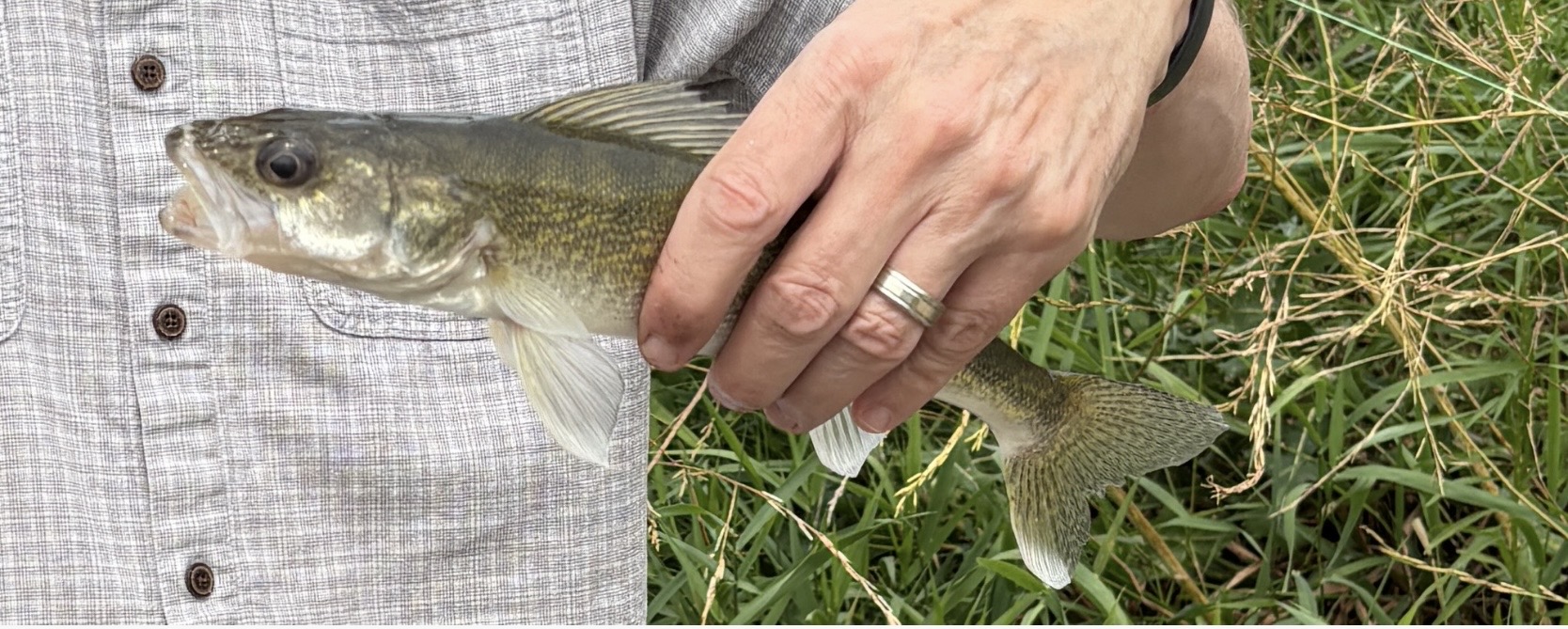
It wasn’t long after I cast it out that I felt a solid bite. This fish fought much harder than the others. As I reeled it in, I told Luke, “I think it’s a Redhorse.”
“No,” he replied. “That’s not a Redhorse. That’s a Walleye!”
Walleye
I was completely surprised. A Walleye was the last fish I expected to catch at that location. I had assumed I would need to fish a northern Minnesota lake or perhaps the Mississippi River before eventually adding one to my 100-species list. So, instead of traveling to a northern Minnesota lake or the Mississippi River, I caught Species #33 right here in Rochester.
I then asked Luke to take a picture of me with the fish but every time Luke got ready to snap a photo, the fish wriggled out of my hands and onto the bank. Luke was laughing hard and after each escape attempt he would say, “Kevin! Hold on to the fish!” Eventually we managed to get a photo.
With this Walleye, I am now one-third of a fish away from being one-third of the way to my goal of 100 fish species. Only a serious fish nerd would think that milestone is worth celebrating, but I do!
I have been wanting to learn more about minnow-sized fish ever since I started my goal of catching 100 fish species this year.
I should clarify that when I say “minnow-sized,” I am referring to small fish, typically 2-4 inches long, and not necessarily members of the Minnow family. Most species in the minnow family are indeed small, but there are notable exceptions, such as the Common Carp, which can grow to enormous sizes. I do not plan to count minnow-sized fish on my 100-species list, but I am nonetheless very interested in learning more about them.
My son-in-law, daughter, and my grandchildren joined me for an outing to the Zumbro River just south of Apache Mall in Rochester, Minnesota. My daughter, who has become an excellent watercolor painter, took a well-deserved break and spent her time under a shady tree painting a beautiful hummingbird. Meanwhile, the rest of us went hunting for minnows.
At first, my son-in-law and I tried using a seine net in the moderately fast-flowing current of the river. We caught exactly zero minnows with that method and eventually gave up. We then noticed that there were large numbers of minnows in the shallow, slow-moving rivulets along the edge of the river.
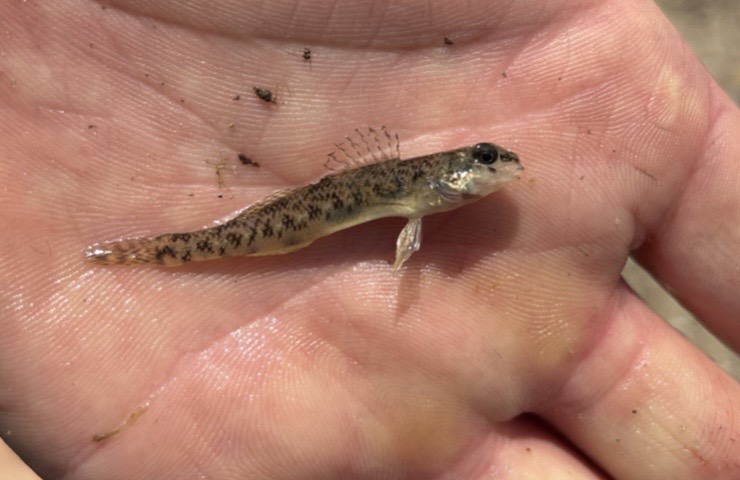
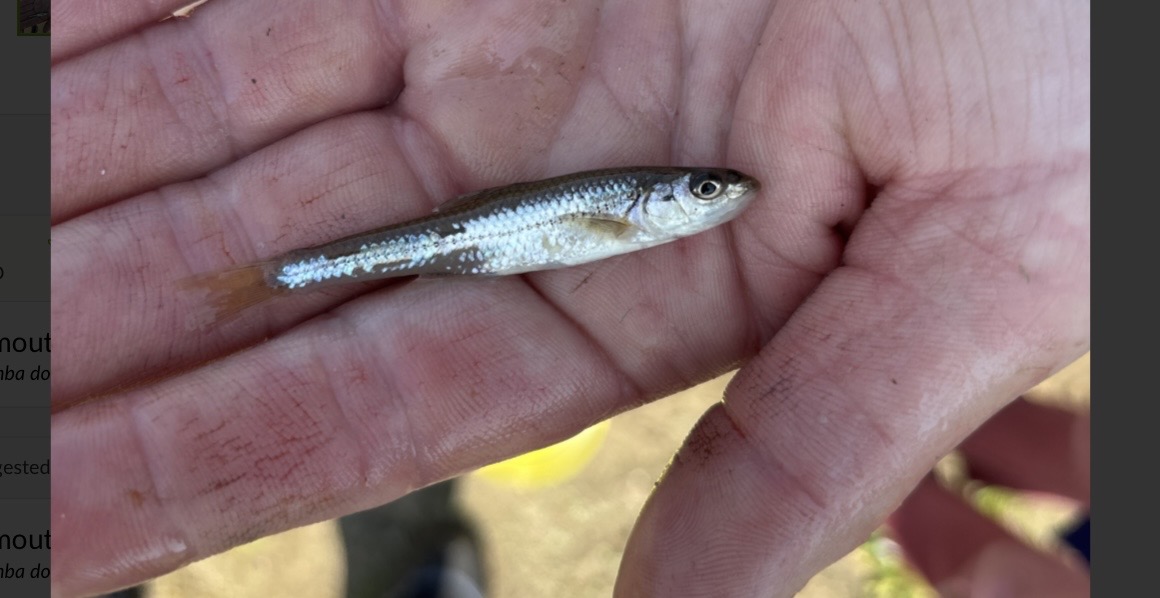
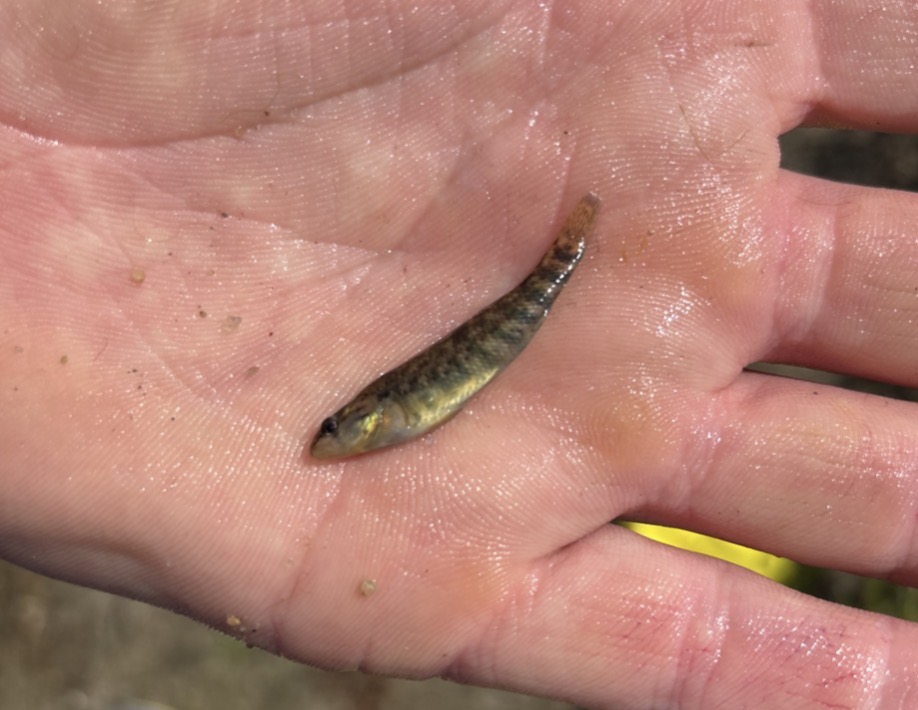
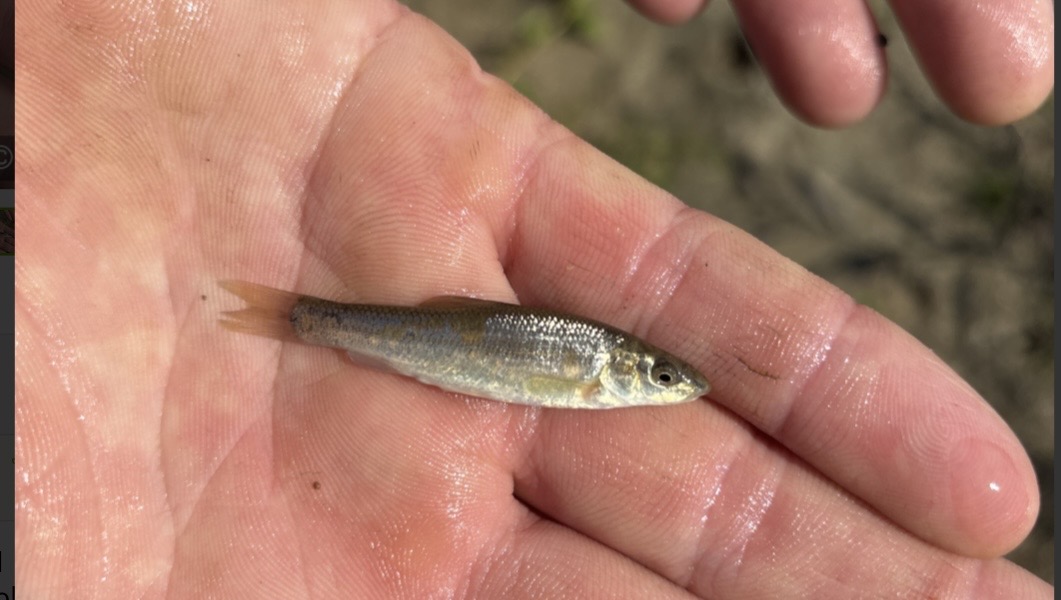
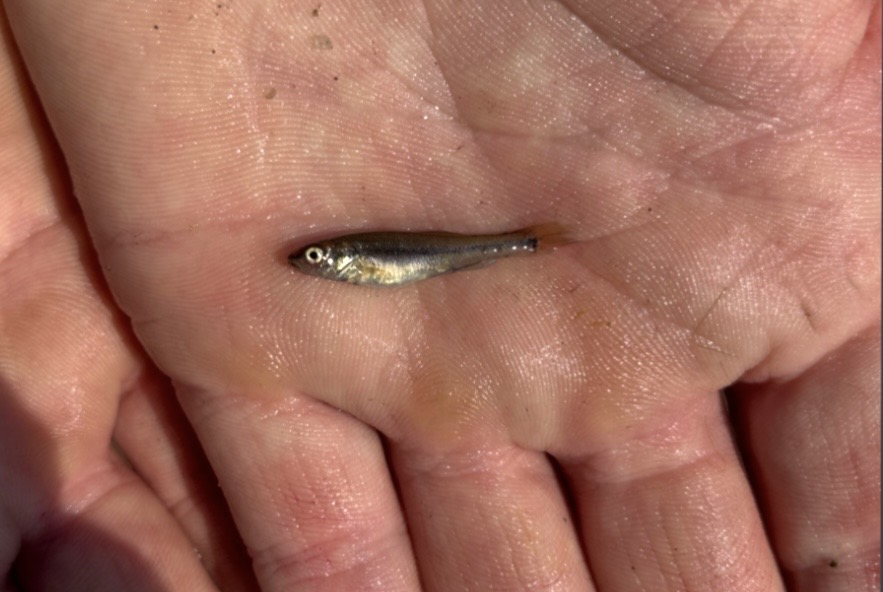
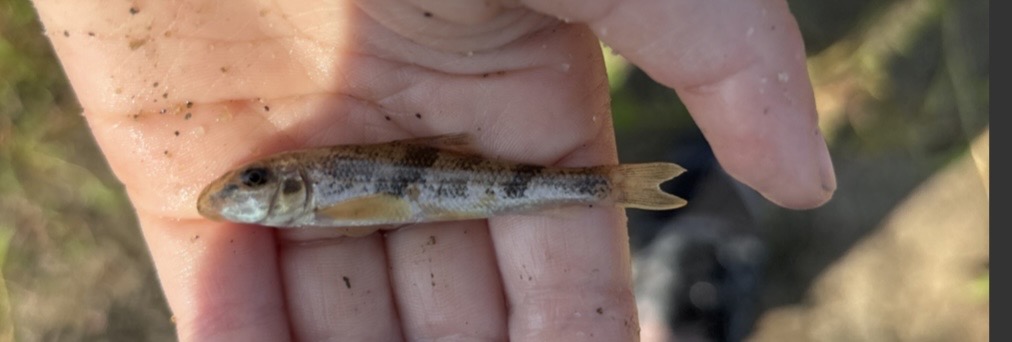
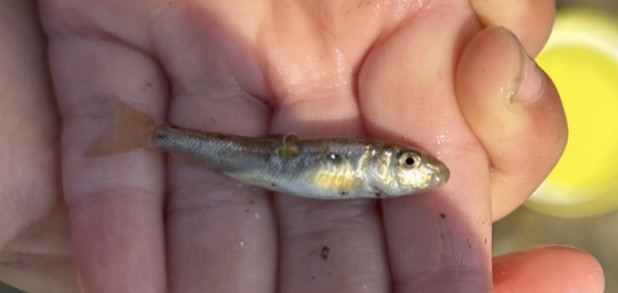
Fortunately, I had also brought a dip net. My son-in-law, who is quite a bit faster than I am, quickly began catching minnows and placing them in a bucket. We photographed each fish and then asked iNaturalist to help identify it.
Among the approximately 50 minnow-sized fish we caught were seven different species:
Johnny DarterBigmouth ShinerRainbow DarterCentral StonerollerCreek ChubNorthern Hog SuckerWhite Sucker
The first four species remain minnow-sized throughout their lives. The last three were juvenile fish that will eventually grow much larger. Adult Creek Chubs typically reach 4-8 inches in length, White Suckers commonly grow to 12-18 inches, and Northern Hogsuckers often reach 10-18 inches.
One thing I learned while researching these fish is that minnow-sized species generally live much shorter lives than larger fish. Shiners, dace, darters, and killifish often live only two to four years, whereas larger species such as suckers, sunfish, bass, and catfish commonly live eight to twenty years or more.
There are several reasons for this difference. First, small fish experience intense predation pressure. They are preyed upon by bass, pike, walleye, herons, turtles, and even larger fish. Second, their high metabolic rates cause them to burn energy quickly and generally age faster. Third, many small species follow a “live fast, reproduce fast” strategy, spawning multiple times each year and producing large numbers of offspring. Finally, the shallow creeks, riffles, and stream margins where many small fish live are often unstable environments that can be affected by floods, droughts, heat waves, and winter freezing.
Fortunately for these species, their short lifespans are offset by rapid reproduction, allowing populations to rebound quickly after environmental setbacks.
We had a very enjoyable afternoon catching fish and learning more about a fascinating group of species that most anglers rarely pay much attention to. Although none of these fish will count toward my 100-species goal, they reminded me that some of the most interesting discoveries in nature come in very small packages.
If you were to ask me just several days ago what various fish eat, I would have been pretty clueless. I knew that many fish eat worms, and some eat minnows and leeches, because you can buy all of those as fishing bait and because I have caught a wide variety of fish with worms over the years.
But I figured that was probably a pretty uneducated understanding of what fish eat, so I looked into it more. It turns out that the diets of fish can be classified into about eight categories: planktivores, piscivores, insectivores, benthivores, molluscivores, detritivores, algivores, and omnivores.
Before I explain what each of those is, it is helpful to know that -vore is Latin for “one who devours.” More precisely, it comes from the Latin verb vorāre, meaning “to devour,” “to swallow greedily,” or “to eat ravenously.”
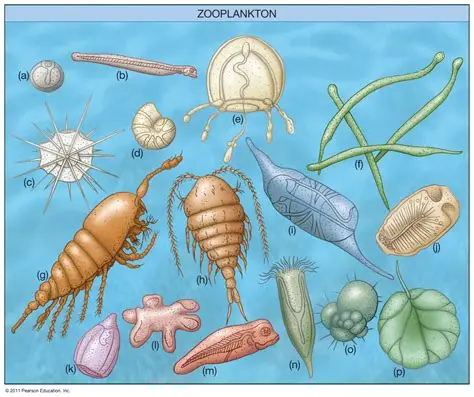
Planktivores are microscopic grazers that feed on zooplankton—for example, tiny drifting animals such as Daphnia, copepods, and rotifers. Examples include juvenile Perch, juvenile Trout, Cisco, Shad, Killifish, and many Minnows. Planktivores are usually small-bodied or juvenile fish. They occupy open water and often form schools. They are the crucial link between microscopic life and larger predators. Almost every fish begins life as a planktivore. Even Pike and Bass start out eating zooplankton before graduating to bigger prey.
Omni- of course means “all,” and consequently omnivorous fish are generalists that eat a mix of plants, insects, small crustaceans, detritus, and sometimes tiny fish. Examples include Bluegill, Carp, Creek Chub, and many Minnows. These fish are adaptable and thrive in ponds, lakes, rivers, and marshes. Their flexibility is why Bluegills dominate many warm-water lakes and why Carp can survive almost anywhere.
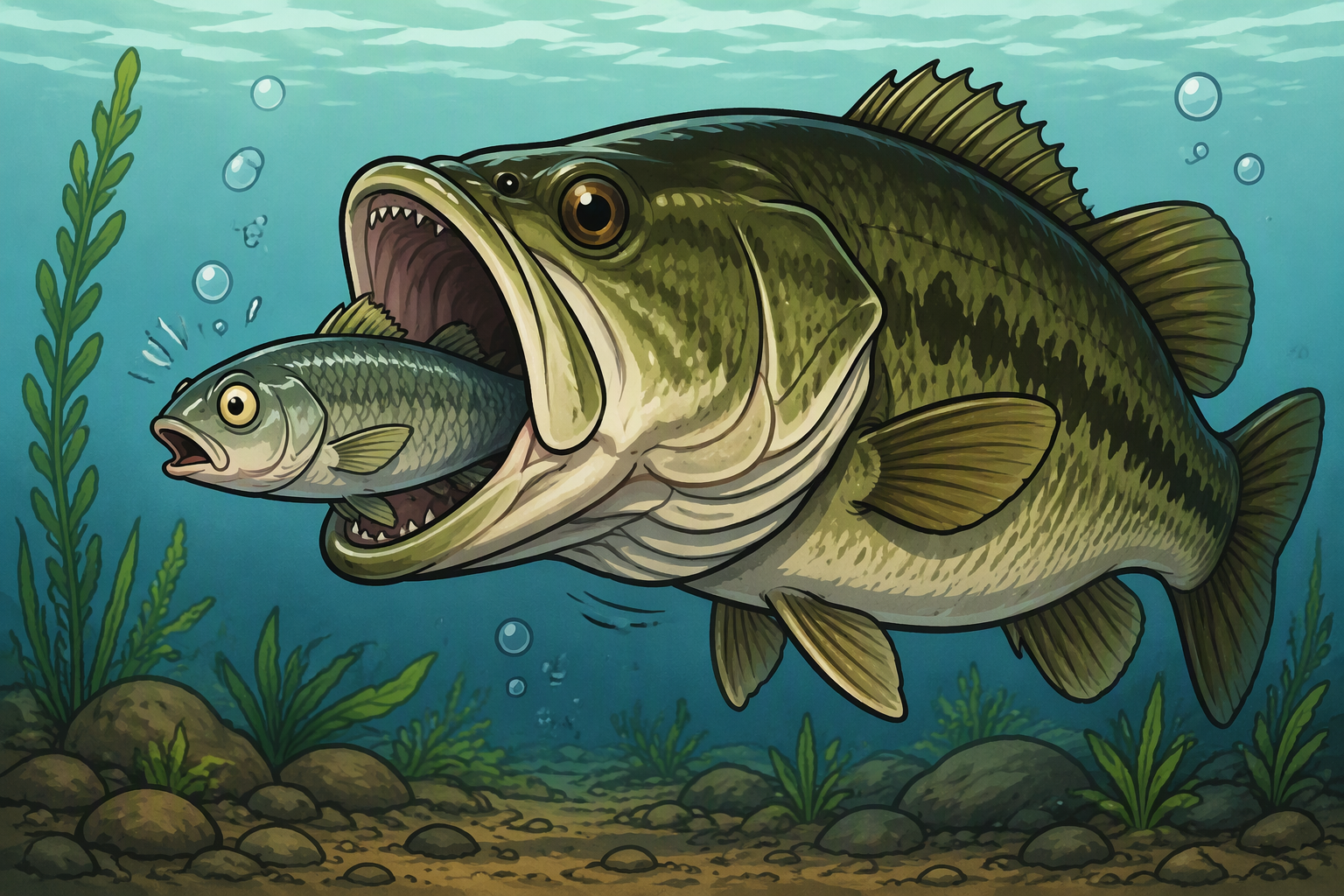
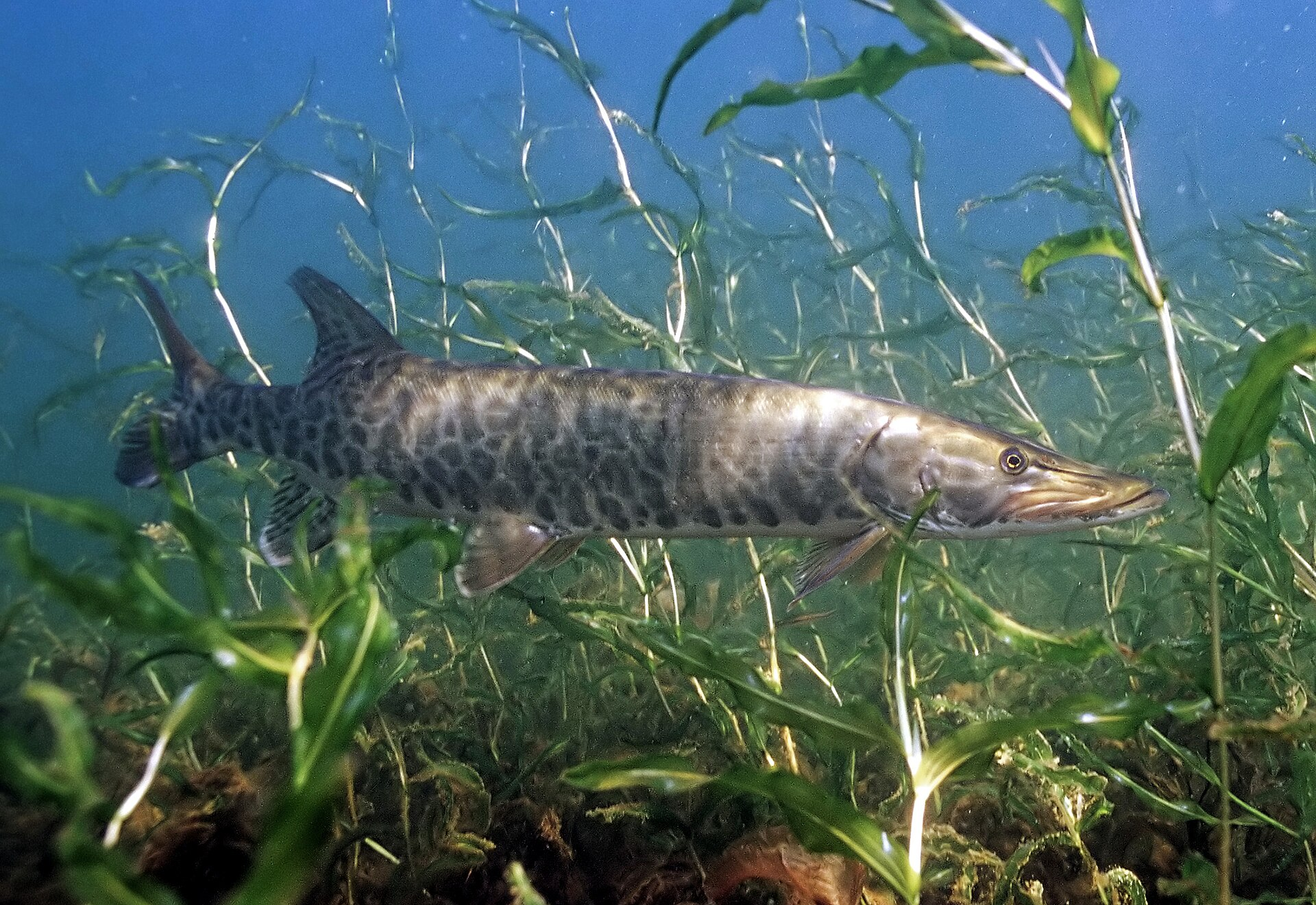
Piscivores eat other fish. They are the apex predators of freshwater systems. Examples include Northern Pike, Muskie, Largemouth Bass, Walleye, Flathead Catfish, Bowfin, and Gar. Piscivores shape fish communities. They control panfish numbers, influence prey behavior, and often determine where other species can safely feed. Their bodies reflect their diets: long jaws, sharp teeth, fast-twitch muscles, and ambush-oriented shapes.
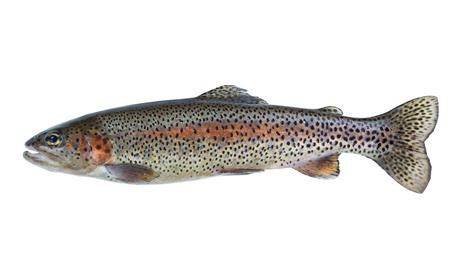
Insectivores feed on aquatic insects such as mayflies, caddisflies, midges, stoneflies, and larvae. Examples include Trout, Darters, many Minnows, and juvenile Bass. These fish rely on clean, oxygen-rich water. Their presence often indicates a healthy stream or lake. Trout are the classic insectivores: they rise to drifting insects, pick larvae off rocks, and track hatches with precision.
Benthivores feed on organisms living on or in the bottom sediments. Examples include suckers, catfish, sturgeon, and sculpins. They eat insect larvae, worms, small crustaceans, and detritus. Their mouths are often downturned, adapted for rooting through or vacuuming the substrate. This category includes many of the species I have spent a lot of time fishing for with bottom rigs—especially suckers, which are classic benthic specialists.
Molluscivores, also known as the “shell crushers,” are fish that specialize in eating snails, clams, and mussels. Examples include Redear Sunfish (the “shellcracker”) and Freshwater Drum. They have strong pharyngeal teeth designed to crush shells. This diet helps control invasive snails and can influence water clarity.
And finally, detritivores and algivores are considered the clean-up crew because they eat algae or decomposing organic matter. Examples include certain Minnows, some Suckers, and various tropical species. They recycle nutrients and help stabilize ecosystems.
It is important to realize that fish diets change as they grow. A single species may pass through multiple feeding categories:
Understanding these transitions explains why fish occupy different habitats at different life stages. Knowing feeding strategies helps predict where fish hold, what bait works, when they feed, how species interact, and why certain lakes produce particular fish communities.
In other words, the next time I put a worm on a hook, I will have a much better idea of what might be interested in eating it.
Yesterday I headed to the Faribault, Minnesota, area, about an hour west of Rochester, hoping to catch something new for my list—perhaps a Common Carp, Bigmouth Buffalo, or Smallmouth Buffalo. I didn’t manage to catch any of those species, but I did catch quite a few fish over the course of the day.
I started by fishing below Smith Mill Dam. I should never complain about catching fish, but it became a little frustrating when I found myself catching bullhead after bullhead, most of them Black Bullheads. I lost track, but I probably caught around 15 of them. I also caught one Smallmouth Bass.
At one point during the morning I noticed what looked like a black oil slick floating on the water. At first I dismissed it as possible pollution. Later, however, I caught a tiny, jet-black fish no larger than a minnow.
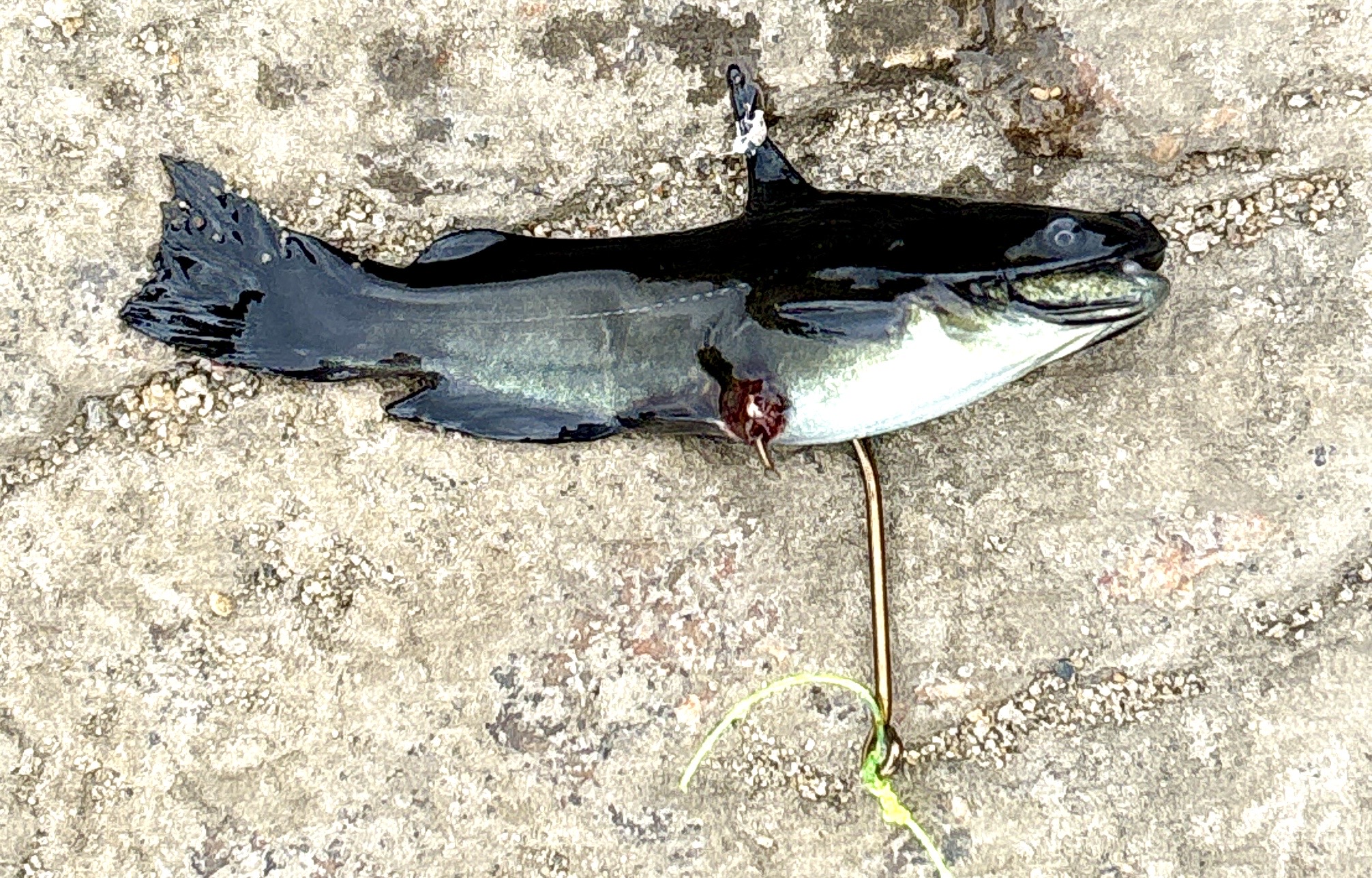
Black Bullhead fry
You can see that it is not much bigger than the hook on which I caught it. In fact, I actually snagged it. I was puzzled by what it was, so I posted the photo to iNaturalist, which identified it as a Black Bullhead. Incidentally, the little rascal managed to poke me with its prominent dorsal spine through my rubber glove while I was unhooking it.
The catch made me think again about the mysterious black slick I had noticed earlier, which was still drifting near where I was fishing. I took a closer look and suddenly realized that the “oil slick” was actually an enormous school of minnow-sized Black Bullheads. The school was at least five feet long and about a foot wide, and I would estimate it contained several thousand fish.
Black Bullhead fry swarm
After doing a little research, I discovered that I had witnessed a phenomenon that appears only briefly each summer—a classic young-of-the-year bullhead swarm. Black Bullheads produce extremely large broods, often numbering between 2,000 and 10,000 fry. After hatching, the fry stay together in a tightly coordinated school that moves almost like a single organism. The group is so dense and dark that it resembles a drifting shadow in the water.
These swarms are typically only a few square feet in size but can contain thousands of jet-black, minnow-sized fry packed so tightly that they appear almost solid. They are usually found in warm, shallow areas with little current. The location where I observed them was a perfect fit.
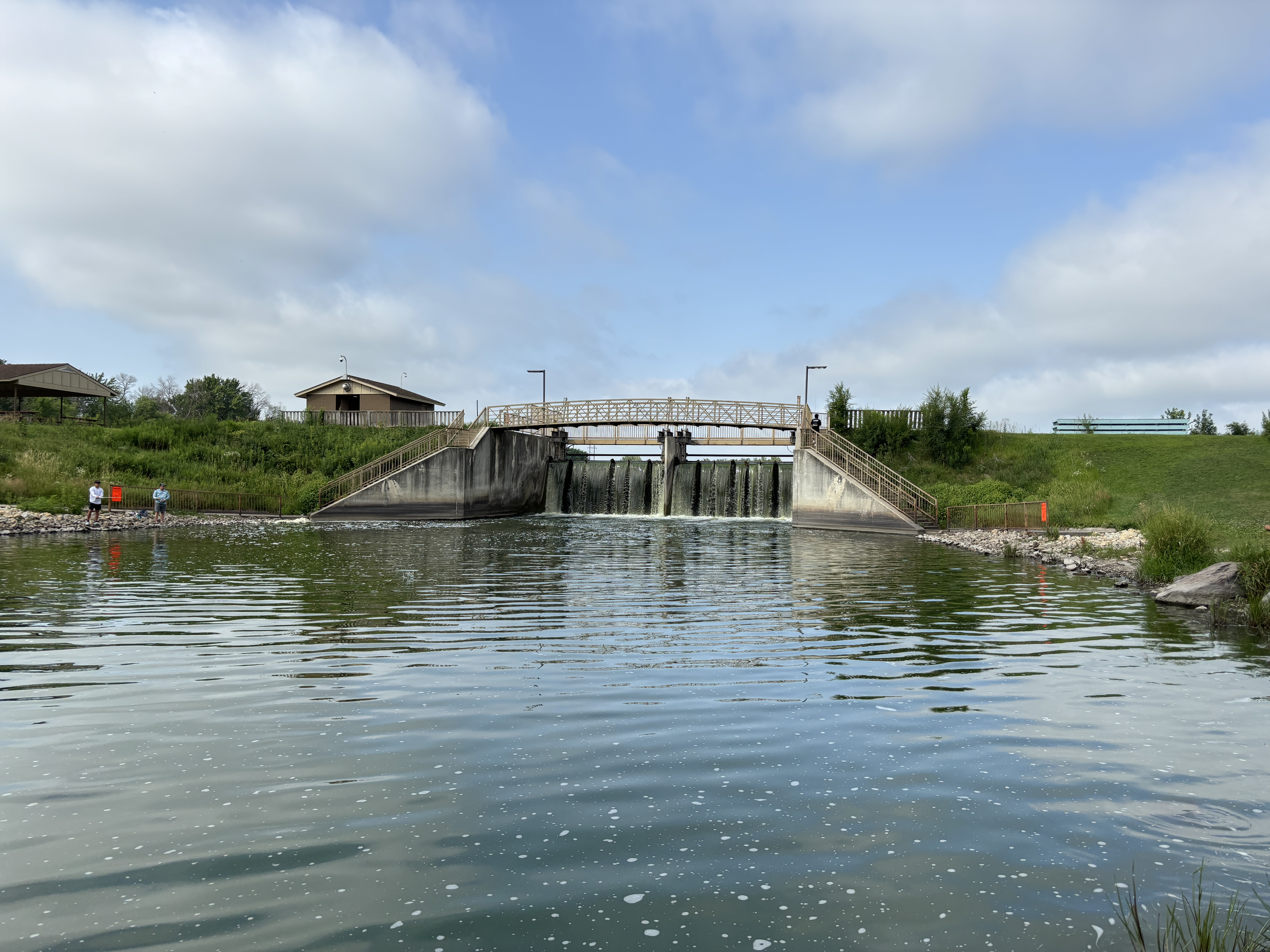
Smith Mill Dam
They were gathered below the dam because bullhead fry prefer warm water, slow current, abundant plankton, and relative protection from predators. The tailwater at Smith Mill provides all of these conditions, and it is common for fry to congregate in sheltered pockets downstream of small dams.
Young bullheads form these dense schools as a predator-avoidance strategy. The swarm makes it more difficult for predators to target individual fish, allows the group to move as a coordinated unit, helps keep the fry in suitable habitat, and provides safety in numbers during one of the most vulnerable stages of their lives. Adult bullheads sometimes guard the young early on, but even after parental care ends, the fry continue schooling until they grow larger.
Bullhead fry swarms are not commonly seen because they exist for only a few weeks each year. So, while I spent much of the morning catching what seemed like an endless succession of bullheads, I was ultimately rewarded with a rare sight. In the end, discovering that living “oil slick” made the morning’s run of bullheads much more understandable—and much more satisfying.
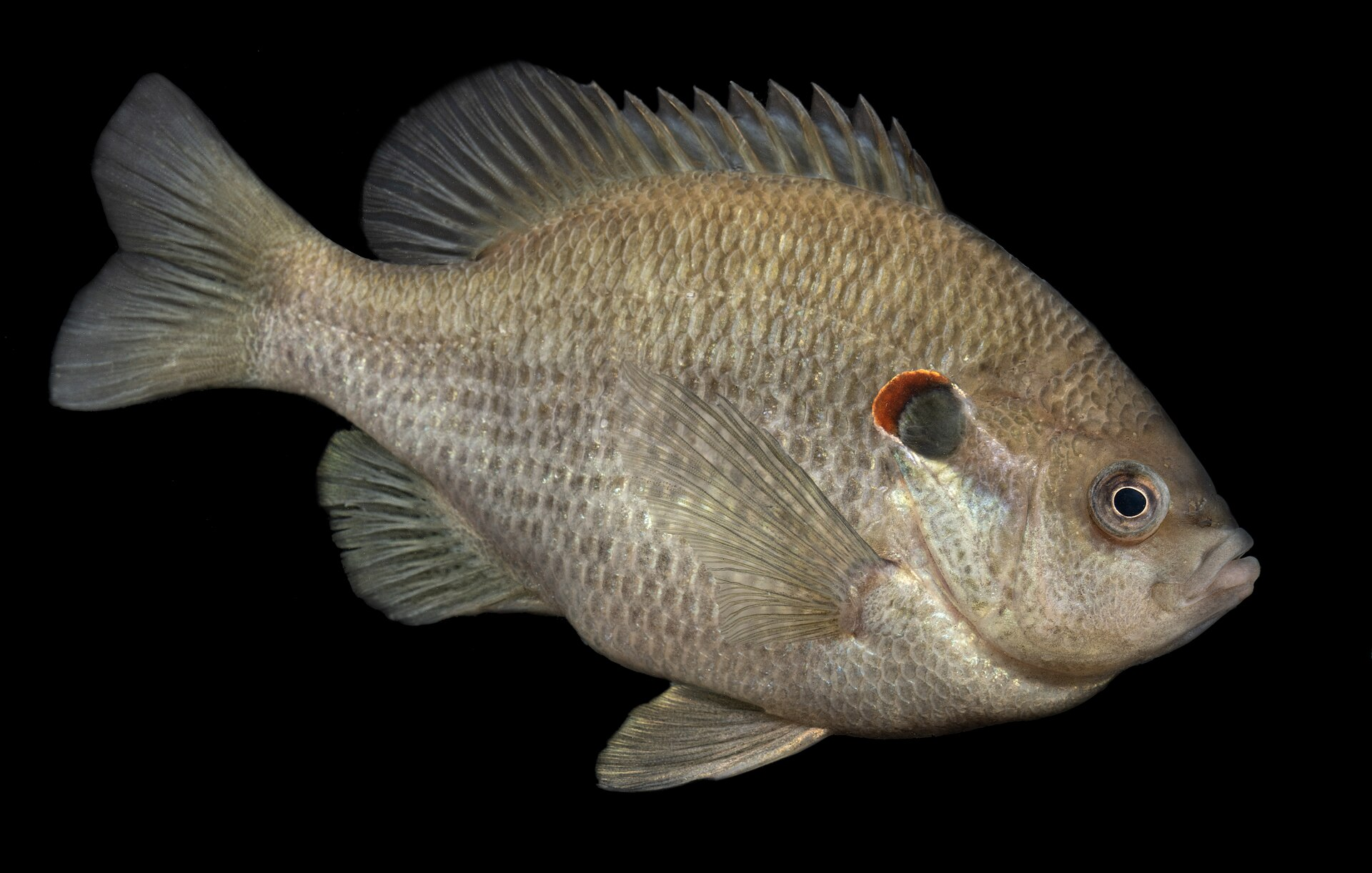
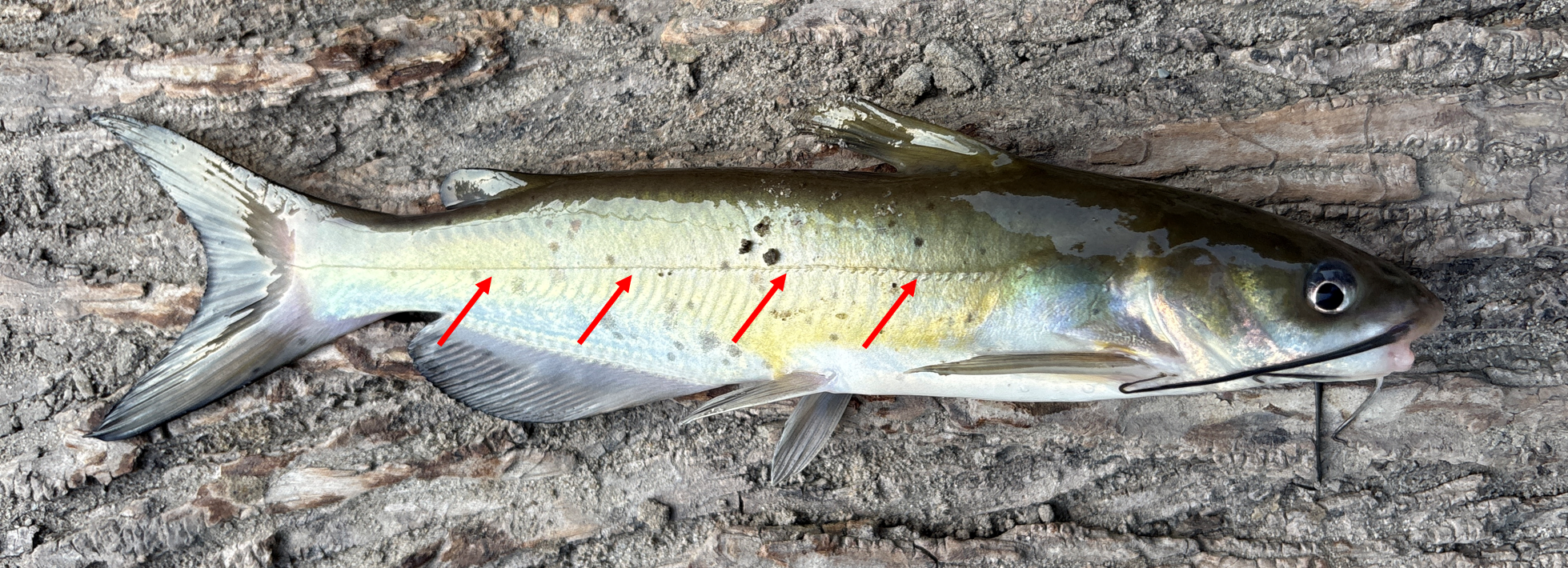
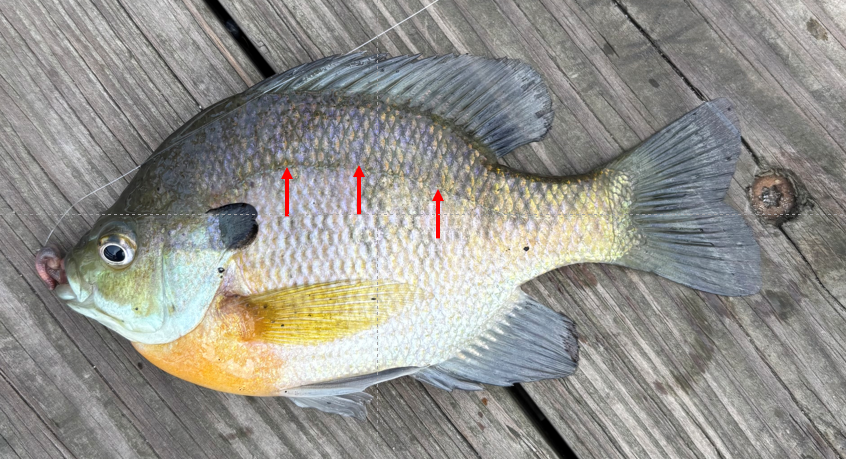
What do the red arrows in the photos of the Channel Catfish and Bluegill Sunfish below point to?
Until I started fishing frequently this year, I was mostly oblivious to the presence of this line that is visible on many fish. Now I notice it all the time. The red arrows point to the lateral line.
But what exactly is a lateral line? Is it just an ornamental marking, or does it serve a purpose?
The answer is that the lateral line is one of the fish’s most important sensory organs. It allows fish to detect water movement, vibrations, pressure changes, and even the motion of nearby objects. In many ways, it functions like a combination of “distant touch” and motion detection.
In many fish, the lateral line appears as a faint line running along the side of the body from just behind the gill cover to the tail. Examples where it is usually easy to see include Walleye, Bass, Perch, Sunfish, and Trout. In these species, the scales that contain lateral-line pores form a visible row that looks like someone drew a line down the side of the fish.
In other species, however, the lateral line may be:
Very faint and difficult to see.
Interrupted, covering only part of the body.
Buried beneath the skin and essentially invisible.
Modified into a series of canals and pits on the head, particularly in bottom-dwelling fish.
So how does it work?
The lateral line consists of tiny sensory structures called neuromasts, which are located in canals beneath the skin or on the surface of the body. Each neuromast contains specialized hair cells covered by a jelly-like structure called a cupula.
When water moves around a fish, the cupula bends. This causes the hair cells to bend as well, generating nerve signals that are sent to the brain. The fish can then determine the direction, strength, and source of the disturbance.
Interestingly, these hair cells are very similar to those found in the human inner ear, which helps us detect sound and maintain balance.
The lateral line provides fish with a remarkable amount of information about their surroundings. It helps them:
Detect approaching predators before they are seen.
Locate prey hidden in darkness or murky water.
Avoid obstacles such as rocks, logs, and shorelines.
Maintain position in flowing water.
Coordinate movements with other fish when schooling.
A fish can often sense the pressure wave created by an approaching predator or prey item before seeing it. In a school of fish, the lateral line helps individuals stay properly spaced and synchronized with their neighbors, allowing the entire school to turn almost instantaneously.
For anglers, the lateral line helps explain several familiar observations:
Why vibrating spinnerbaits can be so effective.
Why rattling crankbaits often work well in stained or muddy water.
Why fish sometimes seem aware of a lure before they can actually see it.
In murky water, a fish may “feel” a lure with its lateral line long before its eyes pick it up.
So there you have it. The lateral line is not just a stripe running down the side of a fish. It’s an important sensory organ that helps fish make sense of the underwater world. I had looked at it for years without really appreciating what it did. Now I suspect I’ll notice it every time I catch a fish.
It has been quite a while since I last caught a new fish species. My previous addition to the list was a Golden Redhorse on July 29. Fortunately, that drought ended today.
To improve my chances of catching a Lake Sturgeon (a new fish for me), I hired a guide named Jarrad. Jarrad told me he has been guiding anglers on the Mississippi River and surrounding waters for 37 years. His business is called Rutting Ridge Outfitters. He helped me catch the Lake Sturgeon I was targeting, was extremely friendly, and taught me a number of things along the way.
Lake Sturgeon
Since we were scheduled to meet about 10 miles north of Winona at 6:30 a.m. (an hour drive from Rochester), I got up at 4:00 a.m. to make sure I arrived on time. I pulled in at about 6:20 and found Jarrad already there and ready to launch his boat.
I had envisioned a long boat ride to our fishing destination, but it turned out to be almost within sight of the launch. We fished near the upper end of Mississippi River Pool 5A, just below U.S. Lock and Dam No. 5. Jarrad explained that sturgeon like this area because food is constantly being carried downstream from the pool above the dam.
Although I was excited about the prospect of catching a Lake Sturgeon, I also felt a little apprehensive. The forecast called for temperatures above 90°F, and I have experienced heat exhaustion—and possibly heatstroke—a couple of times in my life.
One incident occurred many years ago when my brother, his best friend, my best friend, and I went hiking in Canyonlands National Park in Utah. We lost our way and ran out of water before finally finding our way back to our vehicles. The nearest town, Moab, was about 60 miles away. By the time we got there, I was severely overheated. When I reached the hotel, I had dry heaves, but fortunately I recovered without lasting effects.
As it turned out, today was every bit as hot as predicted. There was virtually no wind and not a cloud in the sky. We managed by wearing hats, drinking plenty of water and Gatorade, and periodically soaking our shirts in the river and putting them back on. Even so, we decided to call it a day at about 11:30 a.m.
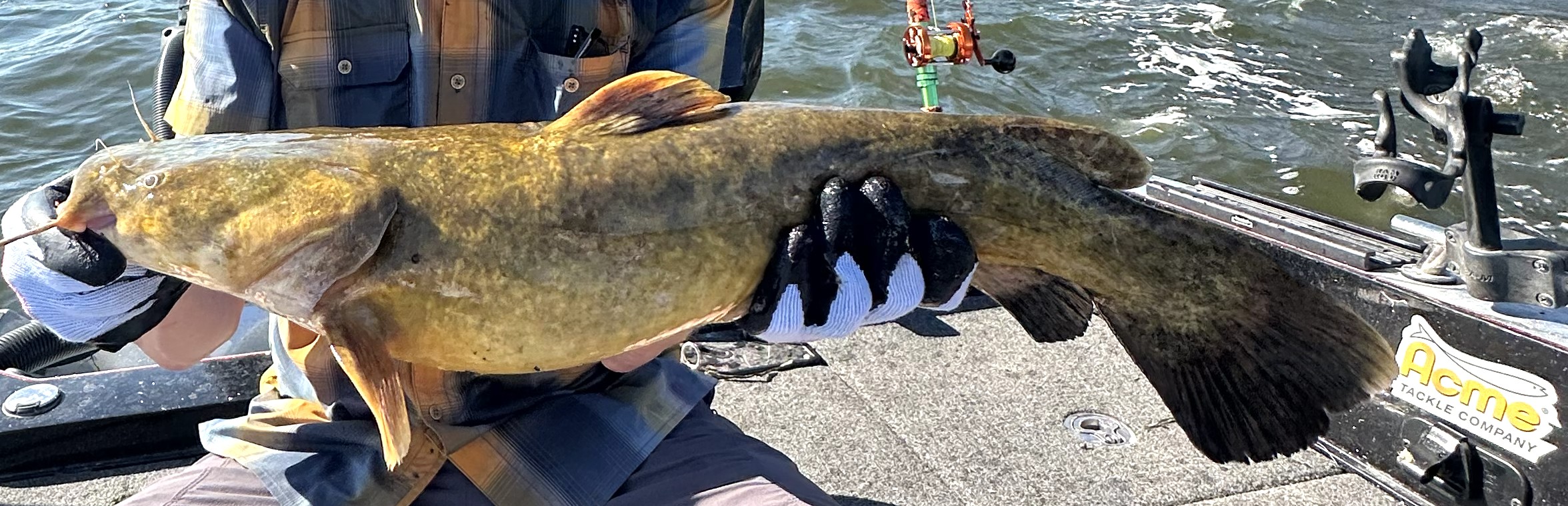
Our first Lake Sturgeon took only about 15 minutes to catch after we positioned ourselves near the dam. As the morning progressed, we landed three more Lake Sturgeon, two Flathead Catfish, and three Channel Catfish. Two of the sturgeon were estimated by Jarrad to weigh a little over 30 pounds. Both the Lake Sturgeon and Flathead Catfish were new species for me.
The Flathead Catfish and Channel Catfish were impressive fish as well, probably weighing between 10 and 20 pounds. In fact, with the exception of the first sturgeon, all of the fish we caught were likely larger than any fish I had ever caught previously. Before today, I don’t think I had ever landed a fish weighing more than about five pounds.
Flathead CatfishChannel Catfish
Incidentally, Jarrad had recently suffered a painful accident. About a week before our trip, while we were making arrangements, he sent me a photograph showing stitches in two fingers on his right hand. He had accidentally cut off the tips of those fingers with a table saw. When I asked what had happened, he replied, “Table saw. The saw won.”
He is still learning how to adapt to tying knots and baiting hooks with his injured hand but appears to be doing very well with that. I ended up helping put quite a few nightcrawlers on the hooks throughout the day to be helpful.
I learned a lot from Jarrad. The fishing rig itself was entirely new to me. We used very heavy braided line—he didn’t specify the pound test, but I would guess it was somewhere between 50 and 100 pounds—along with an 8-ounce pyramid sinker and a massive 8/0 circle hook threaded with two or three nightcrawlers.
As I mentioned in an earlier post, fish essentially hook themselves on circle hooks. Unlike traditional hooks, there is no dramatic hook set. The fish takes the bait, turns away, and the hook catches in the corner of its mouth.
Another first for me was using a baitcasting reel. Most of the casting was done by Jarrad because he knew exactly where he wanted the bait positioned. I suspect he may also have been a little concerned that I would create a spectacular backlash, since I had never used a baitcasting reel before.
However, he did teach me the basics, and I probably made five casts on my own. He explained that you keep your thumb on the spool during the cast and then lightly feather the line as it leaves the reel to prevent tangles. He also showed me how to properly hold large fish for photographs: one hand on the tail and the other supporting the fish near the pectoral fins.
Overall, it was a very satisfying day. I added two new species to my list, caught several of the largest fish of my life, and learned a number of new things about fishing.
In case you haven’t read any of my other posts, I live in Rochester, Minnesota. I’m a soon‑to‑be fully retired molecular pathologist. Over the years I developed genetic tests for diagnosing and guiding treatment for cancer—one example is a urine‑based test for detecting bladder cancer. With my team, I implemented these assays and signed them out to help oncologists and other physicians care for their patients. It’s been a rewarding career, but now it’s time to pursue my many hobbies, one of which is fishing.
I eventually hope to fish in places like Florida, Texas, and California to reach my 100‑species goal, but most days I’m content fishing close to home. Yesterday I woke up at 5 a.m. to get out before the heat—and because the early bird gets the fish.
I started in the tailwaters below the Silver Lake dam and caught a White Sucker, a Bluegill, and three Bullheads (likely black; next time I’ll check the barbel color more carefully to be sure). After that I headed to Foster Arend Lake to fish from the pier. Even at 8 a.m. it was crowded and already hot with no shade. I caught a good‑sized Bluegill, then decided to look for somewhere quieter.
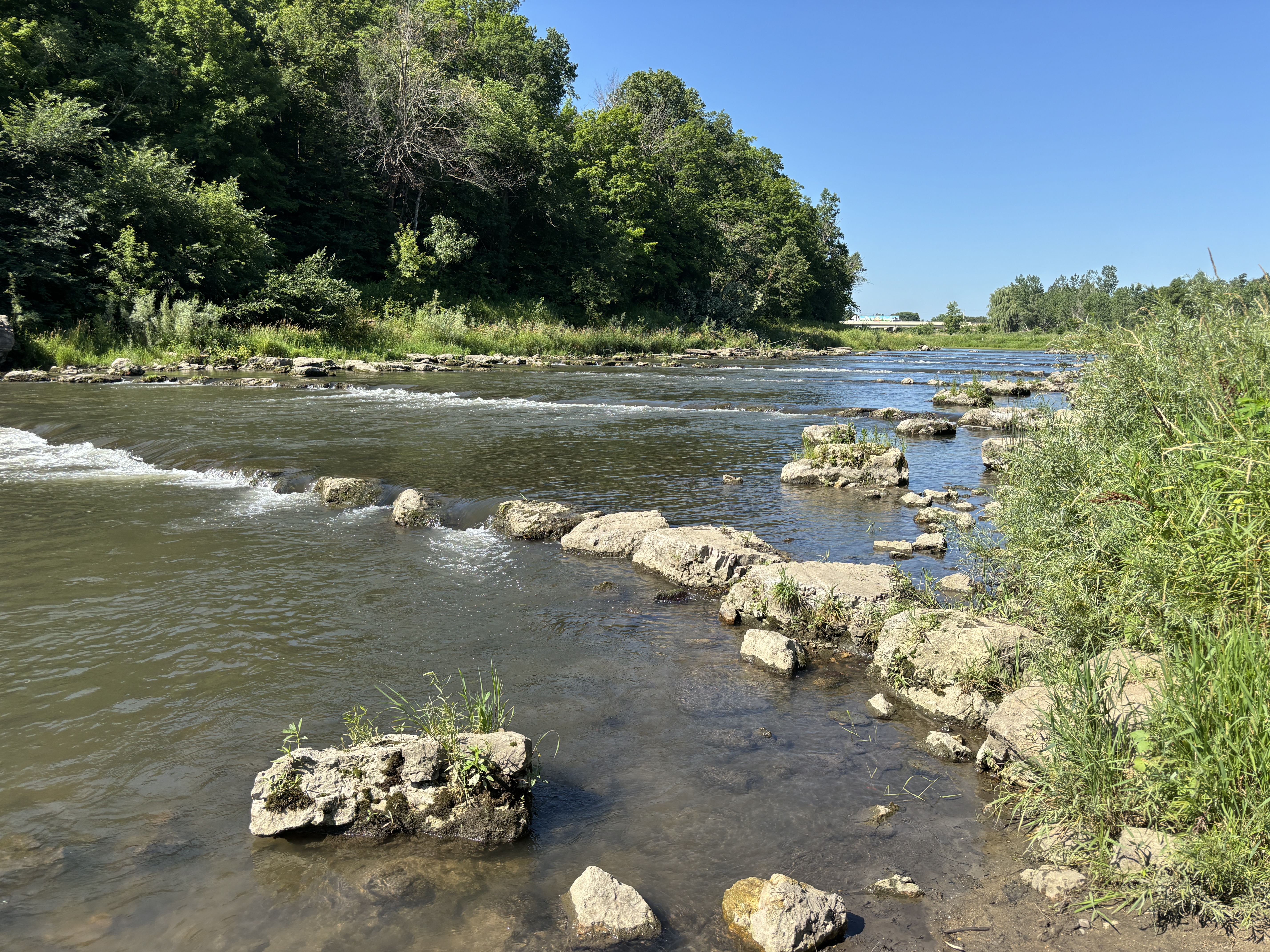
That led me to explore a few places I’d never fished before. I drove north to Oronoco, a town of about 2,000 people roughly ten miles north of Rochester. The Middle Fork of the Zumbro River runs through town. In the 1930s a dam was built to create Lake Shady, a recreational impoundment upstream of downtown. The dam was heavily damaged by a flood in September 2010, and instead of rebuilding it, the city chose a river restoration approach—replacing the dam with a series of rock‑arch rapids. The project was completed in the mid‑2010s and even received engineering awards in 2019.
Middle Fork Zumbro River
Once I arrived, I found the area promising—potentially a good spot for redhorse. I used my usual rig: 6 lb line, a 1/4‑ounce egg sinker, bead, barrel swivel, about 15 inches of monofilament leader, and a size 8 hook. After about five casts I felt what seemed like a snag, but it turned out to be a nice sized Golden Redhorse. I would have stayed longer, but the heat was building and the morning was getting late, so I headed home.
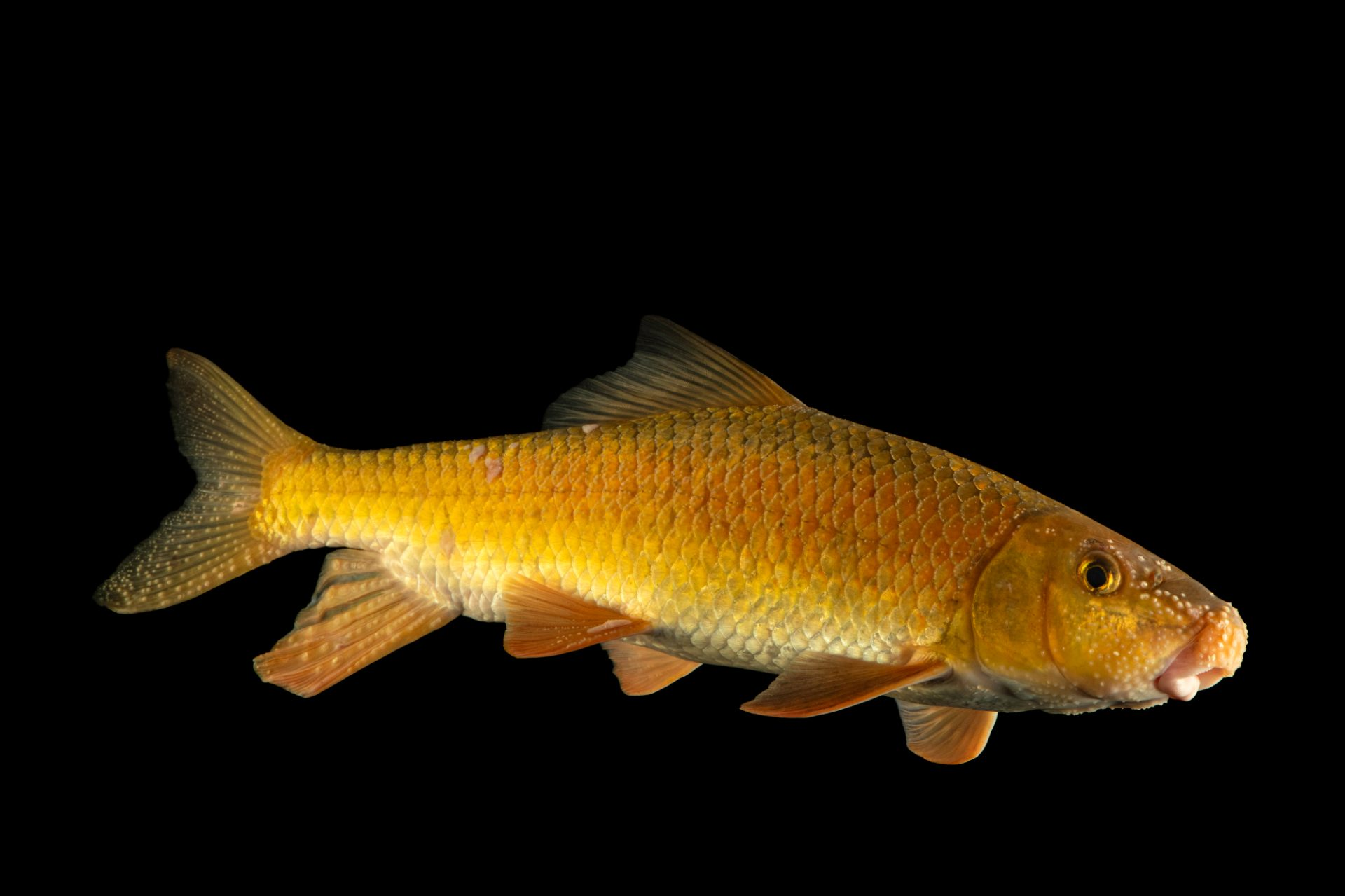
Golden Redhorse
On the walk back to my car I noticed a beautiful Cardinal Flower—probably my favorite wildflower—growing along the path. A perfect ending to an enjoyable morning of fishing.
As I’ve mentioned before, although I’ve fished on and off throughout my life, I wouldn’t consider myself an experienced angler. Over the past several months, I’ve been learning a great deal about the mechanics of fishing. One thing that quickly became apparent is the bewildering variety of hooks available. A visit to any sporting goods store reveals hooks of different sizes, shapes, and designs, with and without barbs. To better understand what works best in different situations, I decided to do a little homework. The figure below shows the basic anatomy of a fishing hook.
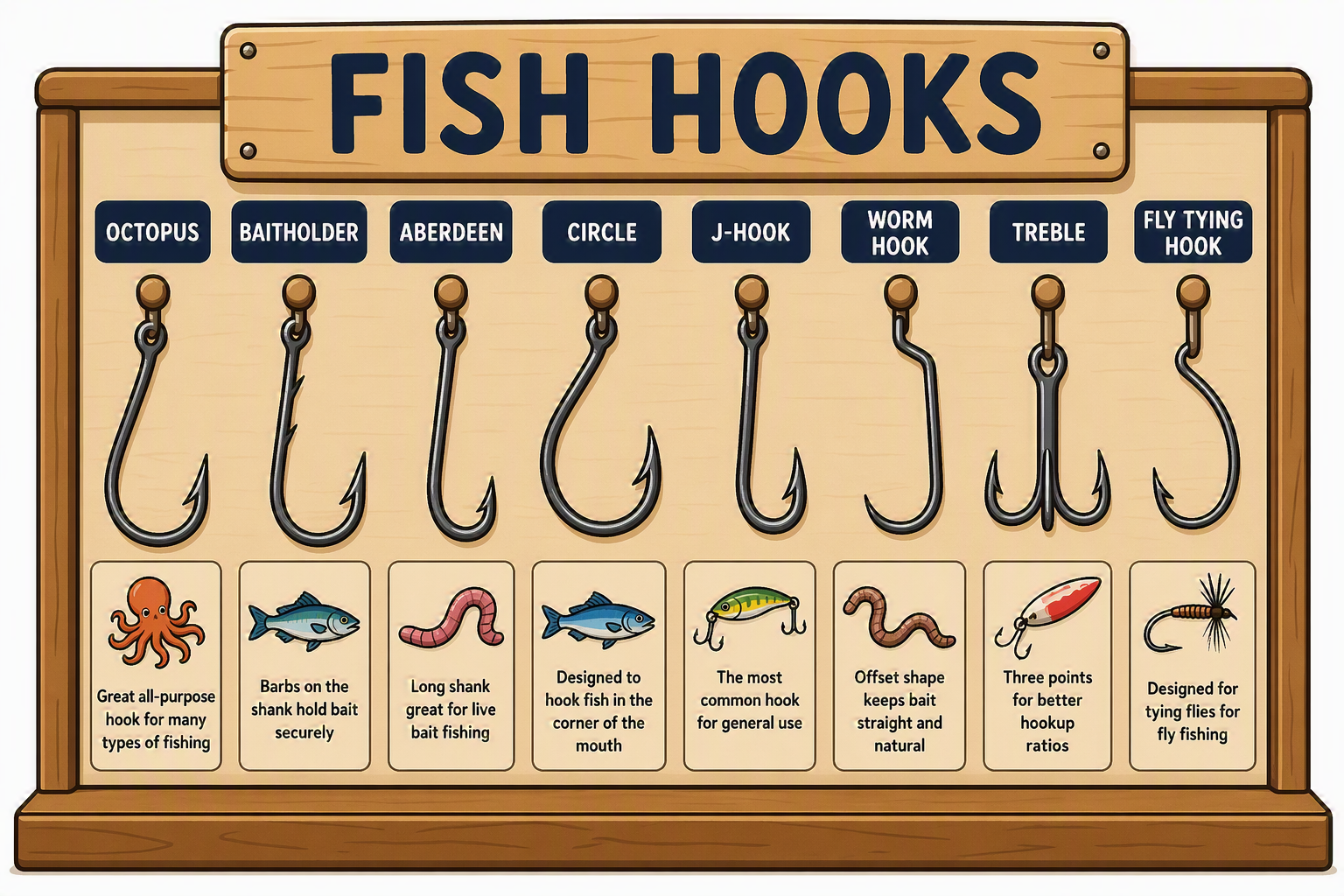
For freshwater fishing, there are roughly half a dozen major hook styles worth knowing. Manufacturers offer countless variations, but most are modifications of these basic designs.
Octopus hooks have a short shank, wide gap, and slightly turned eye. They are extremely versatile and work well with worms, leeches, and minnows for species such as bluegill, crappie, perch, trout, bass, and walleye. Some anglers argue that if you owned only one hook style, an octopus hook would be the best choice.
Baitholder hooks have a longer shank with small barbs along it that help keep worms and other natural baits from sliding off. They are especially useful for nightcrawlers and red worms. The tradeoff is that bait can be harder to remove and the hook is less versatile than an octopus hook. They are commonly used for panfish, perch, and trout.
Aberdeen hooks have a long shank and fine wire. They are ideal for fishing live minnows, particularly for crappies. Their thin wire causes minimal damage to bait, and the long shank makes hook removal easier. They can also sometimes be bent free from snags. The downside is that they can straighten under the strain of larger fish. They are effective for crappie, bluegill, and perch and are widely regarded as a classic Midwestern crappie hook.
Circle hooks have points that curve sharply inward toward the shank. They are most commonly used with live bait and passive presentations. Instead of a hard hookset, the fish effectively hooks itself as the line tightens. Their major advantage is a lower rate of deep-hooked fish, making catch-and-release easier. They are particularly popular for catfish and carp.
Worm hooks feature an offset bend near the eye and are designed primarily for rigging soft plastic worms and other artificial baits. They are a staple of bass fishing.
Treble hooks consist of three hooks joined together. They are commonly found on crankbaits, spoons, and spinners and are used for bass, walleye, trout, and pike. They are generally not used with natural bait.
Finally, fly-tying hooks are small, lightweight hooks specifically designed for tying artificial flies.
For the type of fishing I currently do, I have found that barbless octopus hooks in sizes 4, 6, and 8 handle most of the species I am targeting and simplify both hook removal and catch-and-release fishing.
It’s embarrassing, but I’ve always had a sense of humor about my mistakes, so I’m going to tell it anyway. It also helps explain why, in my quest to catch 100 different fish species, I do most—if not all—of my fishing from shore.
This happened a long time ago, in 2001. I was about 42 years old, and my son was 11. Within the previous year, I had purchased a new Ford F-150 pickup and a new boat, an 18-foot Rinker ski boat. I asked my son if he wanted to spend a weekend fishing in the Brainerd Lakes area of Minnesota.
He said yes, so we packed up and headed north. I think we stayed in a hotel on Friday night and planned to return home Saturday evening. I can’t remember the exact lake. There are so many beautiful lakes in that area, and after 25 years they all tend to blend together.
We launched the boat and spent most of the day fishing. Unfortunately, the fish were not cooperating. By mid-afternoon we had not had a single bite and decided to call it a day.
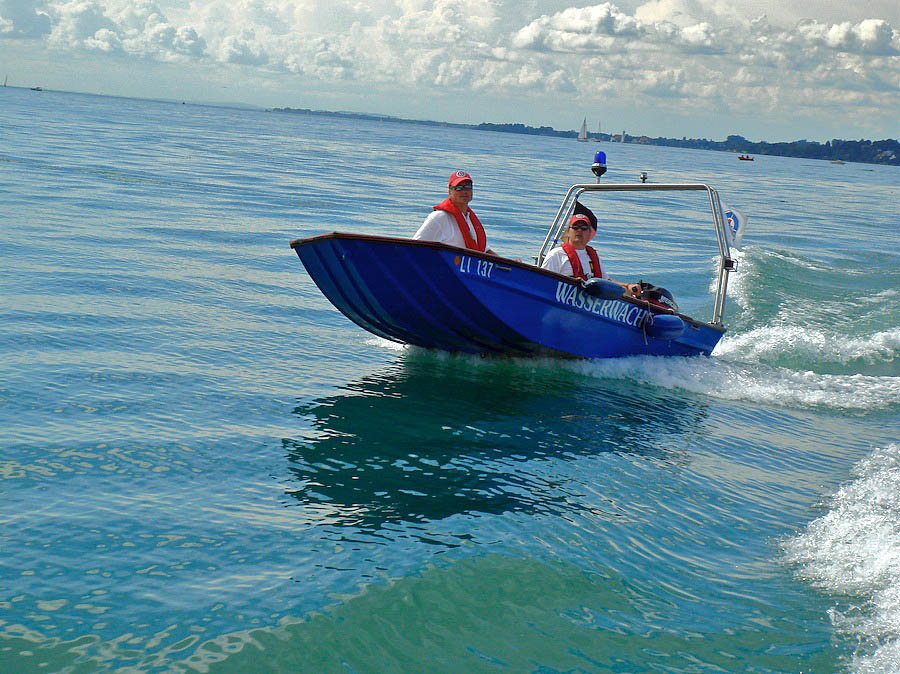
That decision turned out to be the easy part. The boat ramp was extremely steep. As I started pulling the boat out of the water, I heard a scraping sound. From the boat, my son immediately started yelling: “Dad! Stop! Stop! Stop!” I instantly realized my mistake. I had forgotten to trim the outboard motor up before pulling the boat out. I put the truck in park, got out, and went back to the boat to raise the motor. Unfortunately, instead of trimming the motor up, I somehow trimmed it down. That was all it took. The truck’s parking mechanism disengaged, and in an instant the truck began rolling backward down the steep boat ramp toward the lake. I jumped off the boat and made a desperate attempt to get back into the cab and put the truck in park. I didn’t make it. Instead, I fell hard onto the concrete ramp. Fortunately, I missed going under the wheels. Had things been only slightly different, this story might not be getting written. I injured my arm badly in the fall while the truck continued its journey into the lake. The truck ended up window‑deep in the water. Once water gets into the circuitry, the insurance company considers the vehicle totaled, and that’s exactly what happened. The boat sustained damage as well, although it was eventually repaired.
If there is anything funny about the story, it was what we found when we finally opened the driver’s door. About seven sunfish had somehow made their way into the cab of the truck. Those were the only fish we caught all day.
Because of my arm injury, an EMT was called. One of the EMTs was extraordinarily kind and put us up for the night since finding a hotel on short notice would have been difficult.
The whole experience was stressful at the time, but it has become one of those stories that gets funnier with each passing year.
What may surprise you is that I kept the boat for another five years. During that time, I had many enjoyable fishing and water-skiing adventures with both my son and daughter. Eventually, however, we sold it. That reminds me of the old saying that the two best days of a boat owner’s life are the day he buys the boat and the day he sells it.
Now that I’m 67 years old and even less confident in my boating abilities than I was at 42, I’ve decided that shore fishing suits me just fine. I don’t miss launching boats, loading boats, maintaining boats, insuring boats, or writing checks for new boats. I’ve also discovered that rivers often hold a greater variety of fish species than lakes, which is ideal for someone trying to reach 100 species.
That’s not to say I’ll never fish from a boat again. If a particular species requires one, I’ll gladly hire a guide or rent a boat.
I was shooting for Carp again. They have been surprisingly frustrating to catch.
Today was hot as heck—temperatures were in the upper 80s, with sustained winds of 20–35 mph. Still, I felt good about the day. In the morning, I cooked a nice meal of chicken paprikash and Brussels sprouts with bacon and onions. Then, in the afternoon, I met with my advisor from the Office of Staff Services to discuss and plan my retirement this October. With both of those tasks accomplished, I felt I had earned a little time to escape and do some fishing.
My first stop was Silver Lake, where Silver Creek enters the lake on the east side. Several people had reported catching carp there, so I thought it was worth a try. Unfortunately, I didn’t get a single bite. After about 30 minutes of sweltering heat and relentless wind, I decided to move on.
I headed downstream to the tailwaters below the Silver Lake dam. Once again, I targeted Carp using the same simple setup: 6-pound line, a light split shot, a size 8 hook, and a small piece of worm. Below the dam were a series of riffles, a run, and a deeper pool that looked promising.
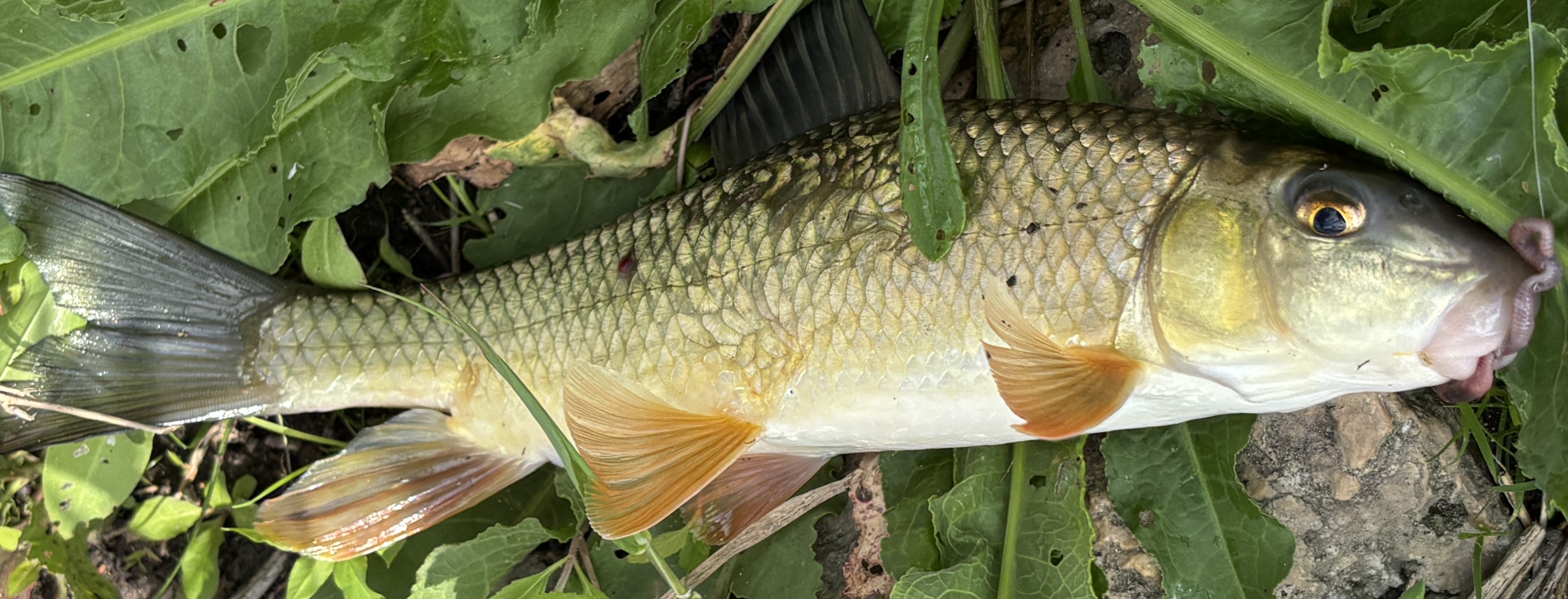
Almost immediately, I started catching fish. The first was an average-sized Black Bullhead—not a new species for me, but always fun to catch. The next fish, however, was much more exciting. It turned out to be a Golden Redhorse, a species I had never caught before. It was a decent-sized fish and put up a respectable fight before coming to hand.
Golden Redhorse
The action continued for the remaining hour that I was there. I caught six more Black Bullheads and a Bluegill, but despite all the activity, I still failed to land a Carp.
That’s okay, though. I’m sure I’ll catch one eventually, and the Golden Redhorse made the trip worthwhile. Adding a new species to my list is always exciting.




 OneHundredFish