What do the red arrows in the photos of the Channel Catfish and Bluegill Sunfish below point to?
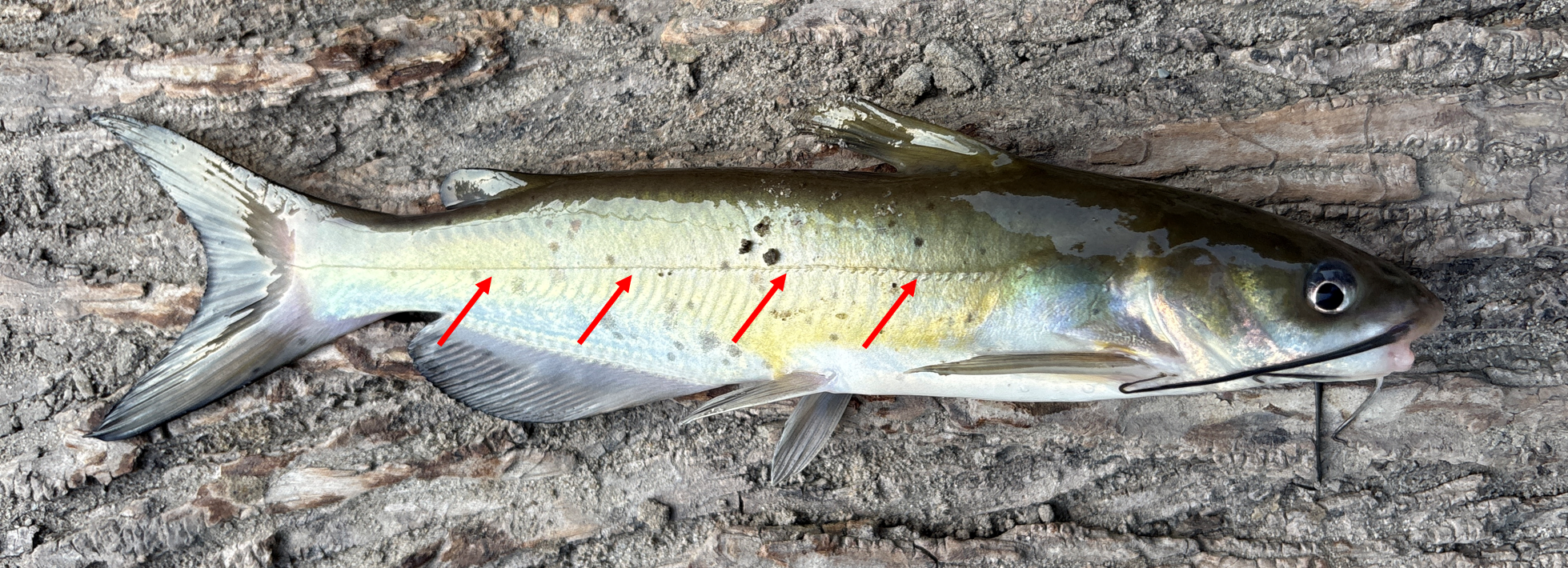
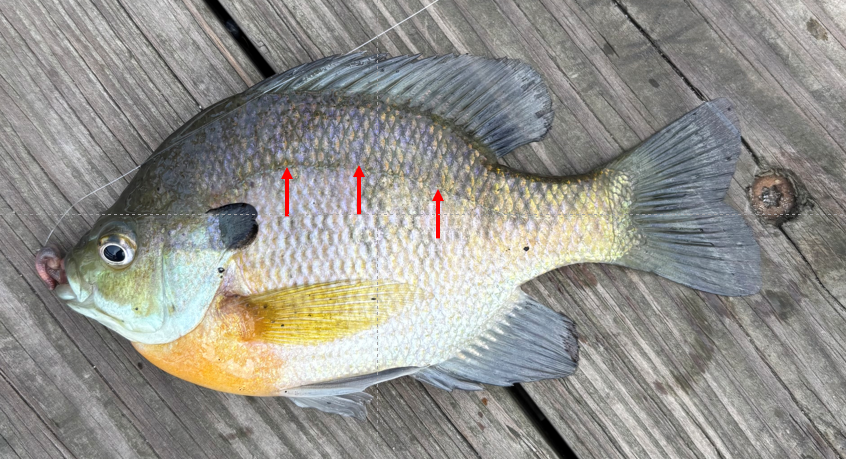
Until I started fishing frequently this year, I was mostly oblivious to the presence of this line that is visible on many fish. Now I notice it all the time. The red arrows point to the lateral line.
But what exactly is a lateral line? Is it just an ornamental marking, or does it serve a purpose?
The answer is that the lateral line is one of the fish’s most important sensory organs. It allows fish to detect water movement, vibrations, pressure changes, and even the motion of nearby objects. In many ways, it functions like a combination of “distant touch” and motion detection.
In many fish, the lateral line appears as a faint line running along the side of the body from just behind the gill cover to the tail. Examples where it is usually easy to see include Walleye, Bass, Perch, Sunfish, and Trout. In these species, the scales that contain lateral-line pores form a visible row that looks like someone drew a line down the side of the fish.
In other species, however, the lateral line may be:
- Very faint and difficult to see.
- Interrupted, covering only part of the body.
- Buried beneath the skin and essentially invisible.
- Modified into a series of canals and pits on the head, particularly in bottom-dwelling fish.
So how does it work?
The lateral line consists of tiny sensory structures called neuromasts, which are located in canals beneath the skin or on the surface of the body. Each neuromast contains specialized hair cells covered by a jelly-like structure called a cupula.
When water moves around a fish, the cupula bends. This causes the hair cells to bend as well, generating nerve signals that are sent to the brain. The fish can then determine the direction, strength, and source of the disturbance.
Interestingly, these hair cells are very similar to those found in the human inner ear, which helps us detect sound and maintain balance.
The lateral line provides fish with a remarkable amount of information about their surroundings. It helps them:
- Detect approaching predators before they are seen.
- Locate prey hidden in darkness or murky water.
- Avoid obstacles such as rocks, logs, and shorelines.
- Maintain position in flowing water.
- Coordinate movements with other fish when schooling.
A fish can often sense the pressure wave created by an approaching predator or prey item before seeing it. In a school of fish, the lateral line helps individuals stay properly spaced and synchronized with their neighbors, allowing the entire school to turn almost instantaneously.
For anglers, the lateral line helps explain several familiar observations:
- Why vibrating spinnerbaits can be so effective.
- Why rattling crankbaits often work well in stained or muddy water.
- Why fish sometimes seem aware of a lure before they can actually see it.
In murky water, a fish may “feel” a lure with its lateral line long before its eyes pick it up.
So there you have it. The lateral line is not just a stripe running down the side of a fish. It’s an important sensory organ that helps fish make sense of the underwater world. I had looked at it for years without really appreciating what it did. Now I suspect I’ll notice it every time I catch a fish.
 OneHundredFish