Yesterday, smoke from the wildfires in northern Minnesota and Canada drifted into southeastern Minnesota, producing some of the worst air quality Rochester has experienced this summer. The AirNow website showed an air quality index of 151 for Rochester—bright red on the map and categorized as “unhealthy.” Since the smoke appeared to be less severe farther west, I decided to spend the evening fishing around Mankato.
My target species were Silver Redhorse, Smallmouth or Bigmouth Buffalo, and Common Carp. I started at the Kiwanis Recreation Area on the Minnesota River just north of Mankato. Unfortunately, access to the river was difficult because of the steep banks. After finding a fishable spot and waiting about twenty minutes without a bite, I moved on.
My next idea was to fish below Rapidan Dam, but that turned into a wild-goose chase. The dam area has been heavily impacted by flooding and is now being decommissioned, leaving no practical fishing access.
I finally settled on Sibley Park, a beautiful park in Mankato situated near the confluence of the Blue Earth and Minnesota Rivers. Once I finally got a line in the water, I began catching several small fish that I initially assumed were Yellow Bullheads. After taking a closer look, however, I began to have doubts. The fish seemed much too sleek and handsome for a bullhead, and I wondered if they might instead be juvenile Channel Catfish. After posting a photograph to iNaturalist, my suspicion was confirmed.
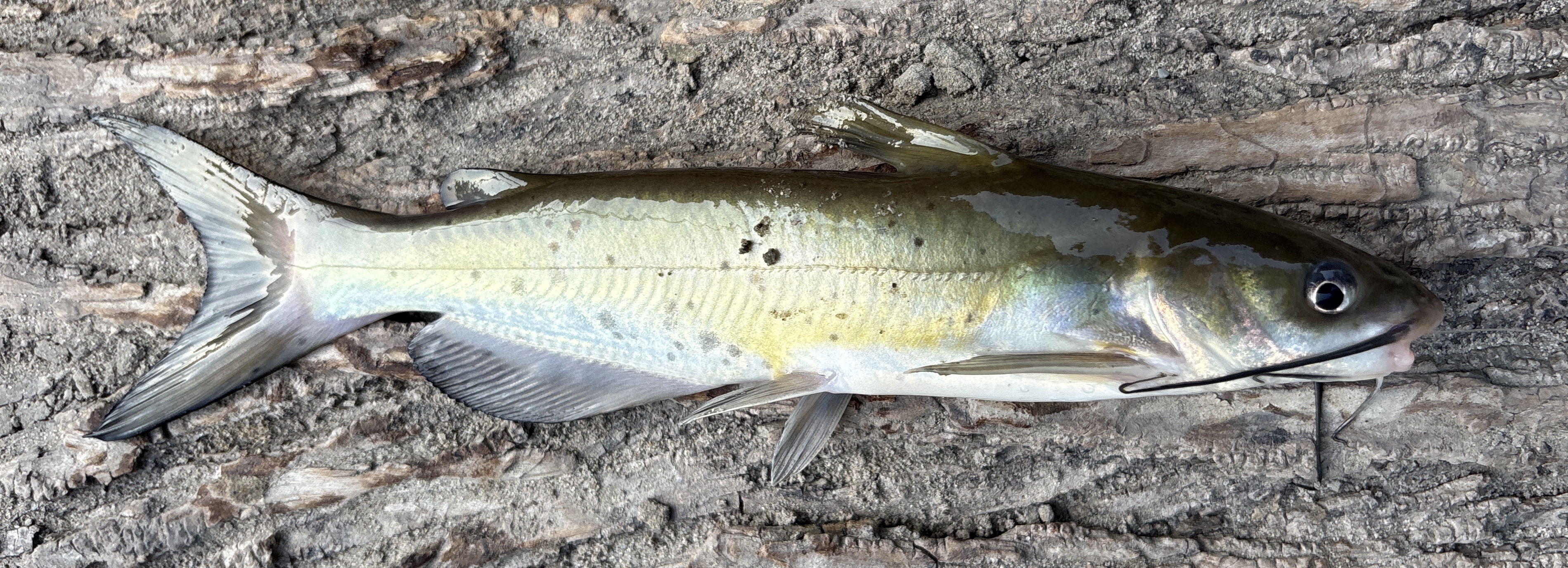

The most obvious field mark that distinguishes the fish I caught from a Yellow Bullhead is the deeply forked tail. Bullheads have a square or only slightly rounded tail, whereas Channel Catfish have a distinctly forked one. The fish also had a long, streamlined body, a relatively small and narrow head, silvery-blue coloration with an olive back, and faint dark spotting along the sides, all features consistent with a juvenile Channel Catfish.
What struck me most was how different these juvenile Channel Catfish looked from the large adults I had caught previously. Large channel cats develop broad heads, heavy jaws, and thick barbels that give them an impressive, rugged appearance. In contrast, these young fish were remarkably elegant. Their streamlined bodies, forked tails, and subtle iridescence created flashes of blue, silver, and gold in the sunlight.
Although the Channel Catfish was not a new species for my list, the outing was nevertheless satisfying. Catching these juvenile fish gave me a deeper appreciation for a species I thought I already knew. Having previously caught only larger Channel Catfish, I had never really noticed how sleek, elegant, and attractive the young fish can be.
 OneHundredFish