Bullhead Slick

Yesterday I headed to the Faribault, Minnesota, area, about an hour west of Rochester, hoping to catch something new for my list—perhaps a Common Carp, Bigmouth Buffalo, or Smallmouth Buffalo. I didn’t manage to catch any of those species, but I did catch quite a few fish over the course of the day.

I started by fishing below Smith Mill Dam. I should never complain about catching fish, but it became a little frustrating when I found myself catching bullhead after bullhead, most of them Black Bullheads. I lost track, but I probably caught around 15 of them. I also caught one Smallmouth Bass.

At one point during the morning I noticed what looked like a black oil slick floating on the water. At first I dismissed it as possible pollution. Later, however, I caught a tiny, jet-black fish no larger than a minnow.
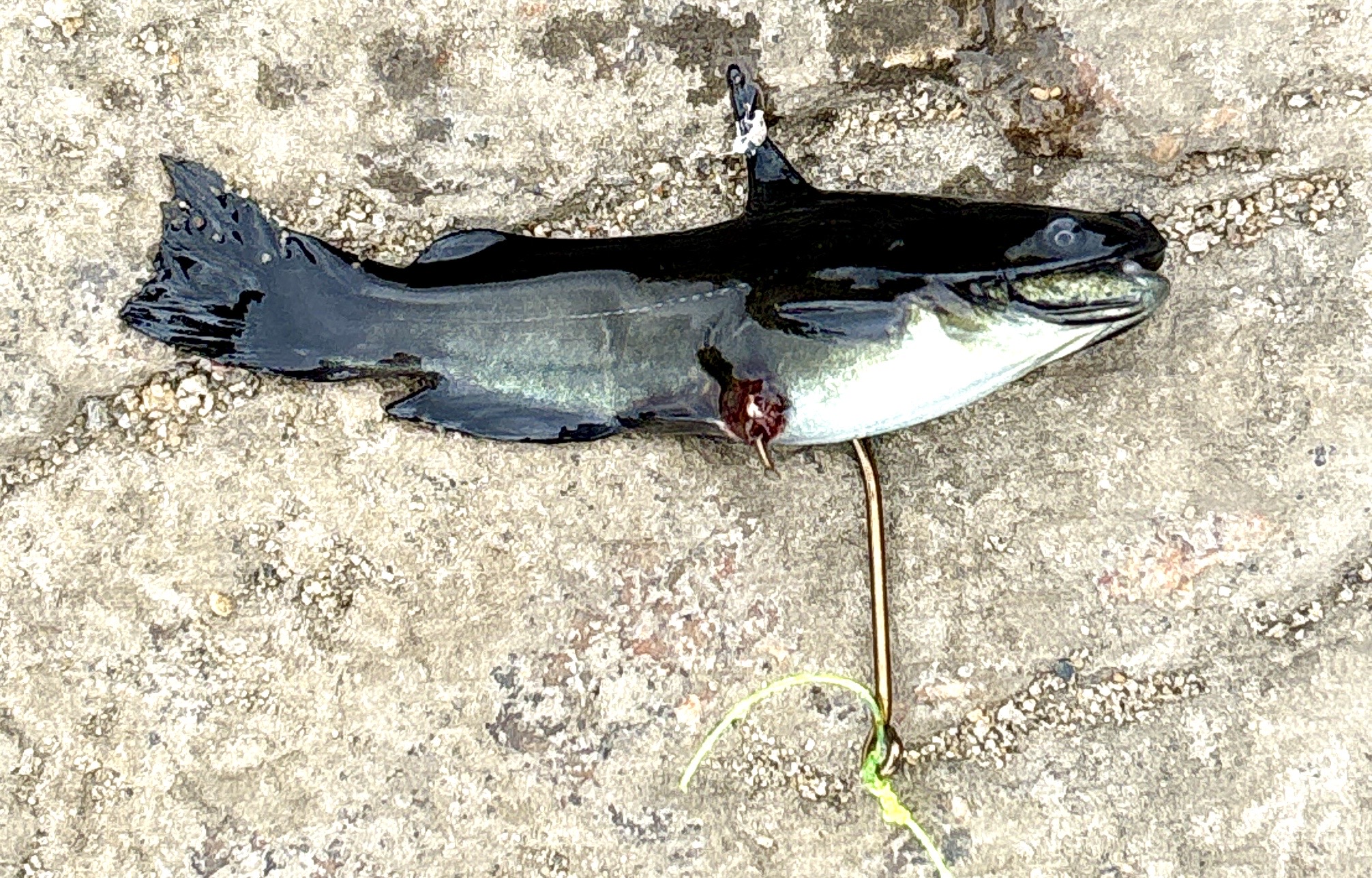
Black Bullhead fry

You can see that it is not much bigger than the hook on which I caught it. In fact, I actually snagged it. I was puzzled by what it was, so I posted the photo to iNaturalist, which identified it as a Black Bullhead. Incidentally, the little rascal managed to poke me with its prominent dorsal spine through my rubber glove while I was unhooking it.

The catch made me think again about the mysterious black slick I had noticed earlier, which was still drifting near where I was fishing. I took a closer look and suddenly realized that the “oil slick” was actually an enormous school of minnow-sized Black Bullheads. The school was at least five feet long and about a foot wide, and I would estimate it contained several thousand fish.

Black Bullhead fry swarm

After doing a little research, I discovered that I had witnessed a phenomenon that appears only briefly each summer—a classic young-of-the-year bullhead swarm. Black Bullheads produce extremely large broods, often numbering between 2,000 and 10,000 fry. After hatching, the fry stay together in a tightly coordinated school that moves almost like a single organism. The group is so dense and dark that it resembles a drifting shadow in the water.

These swarms are typically only a few square feet in size but can contain thousands of jet-black, minnow-sized fry packed so tightly that they appear almost solid. They are usually found in warm, shallow areas with little current. The location where I observed them was a perfect fit.
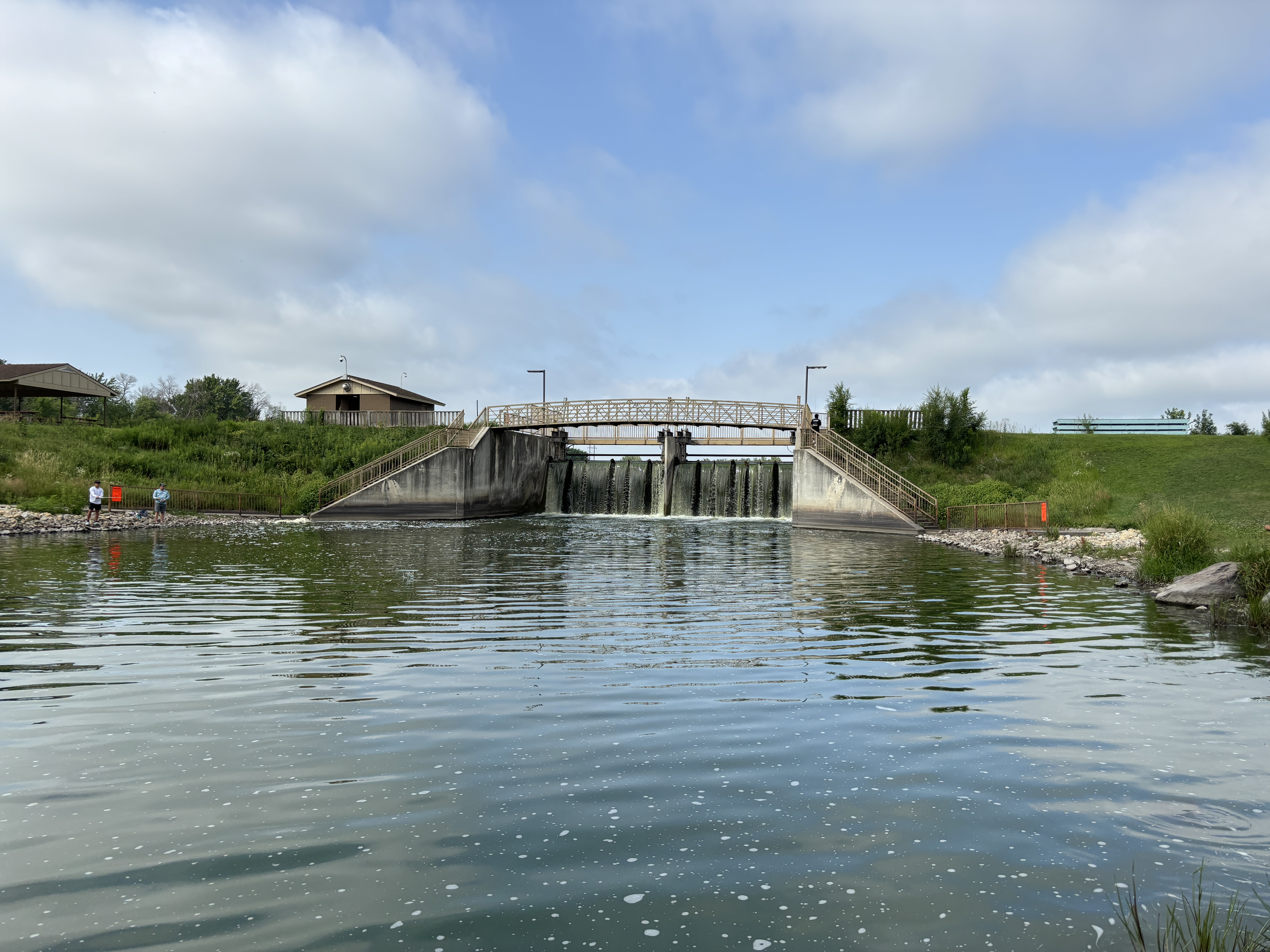
Smith Mill Dam

They were gathered below the dam because bullhead fry prefer warm water, slow current, abundant plankton, and relative protection from predators. The tailwater at Smith Mill provides all of these conditions, and it is common for fry to congregate in sheltered pockets downstream of small dams.

Young bullheads form these dense schools as a predator-avoidance strategy. The swarm makes it more difficult for predators to target individual fish, allows the group to move as a coordinated unit, helps keep the fry in suitable habitat, and provides safety in numbers during one of the most vulnerable stages of their lives. Adult bullheads sometimes guard the young early on, but even after parental care ends, the fry continue schooling until they grow larger.

Bullhead fry swarms are not commonly seen because they exist for only a few weeks each year. So, while I spent much of the morning catching what seemed like an endless succession of bullheads, I was ultimately rewarded with a rare sight. In the end, discovering that living “oil slick” made the morning’s run of bullheads much more understandable—and much more satisfying.
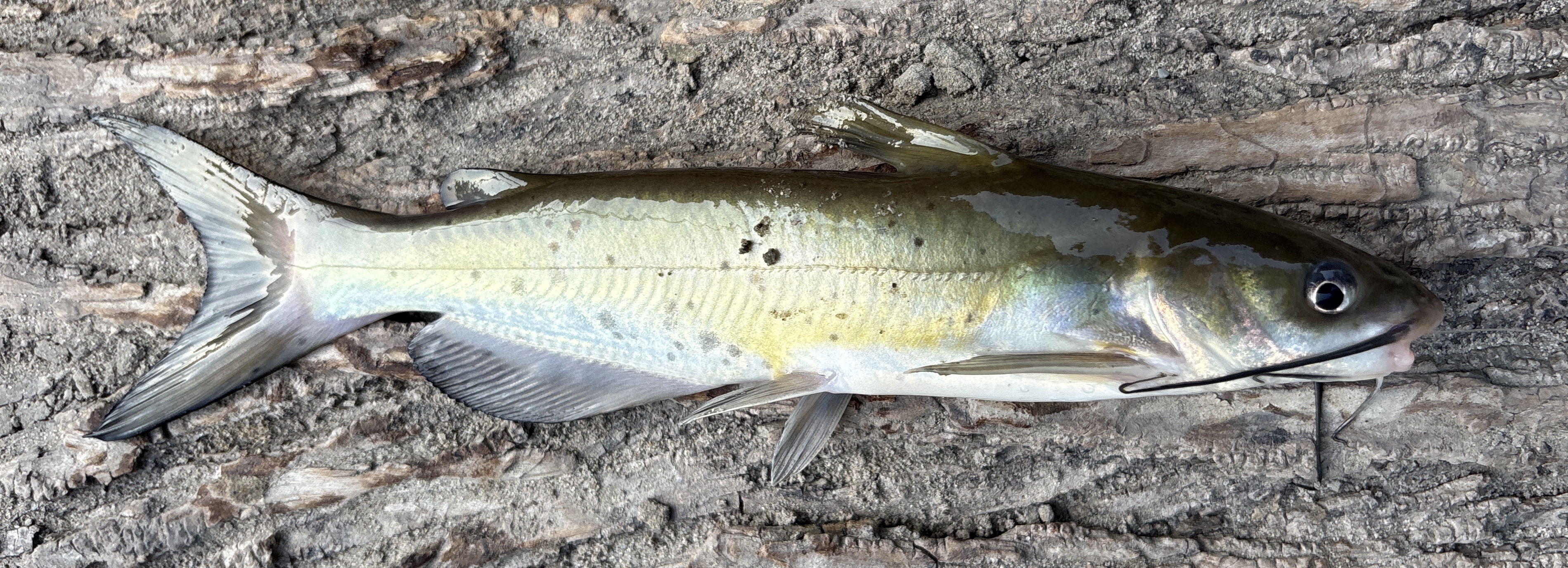
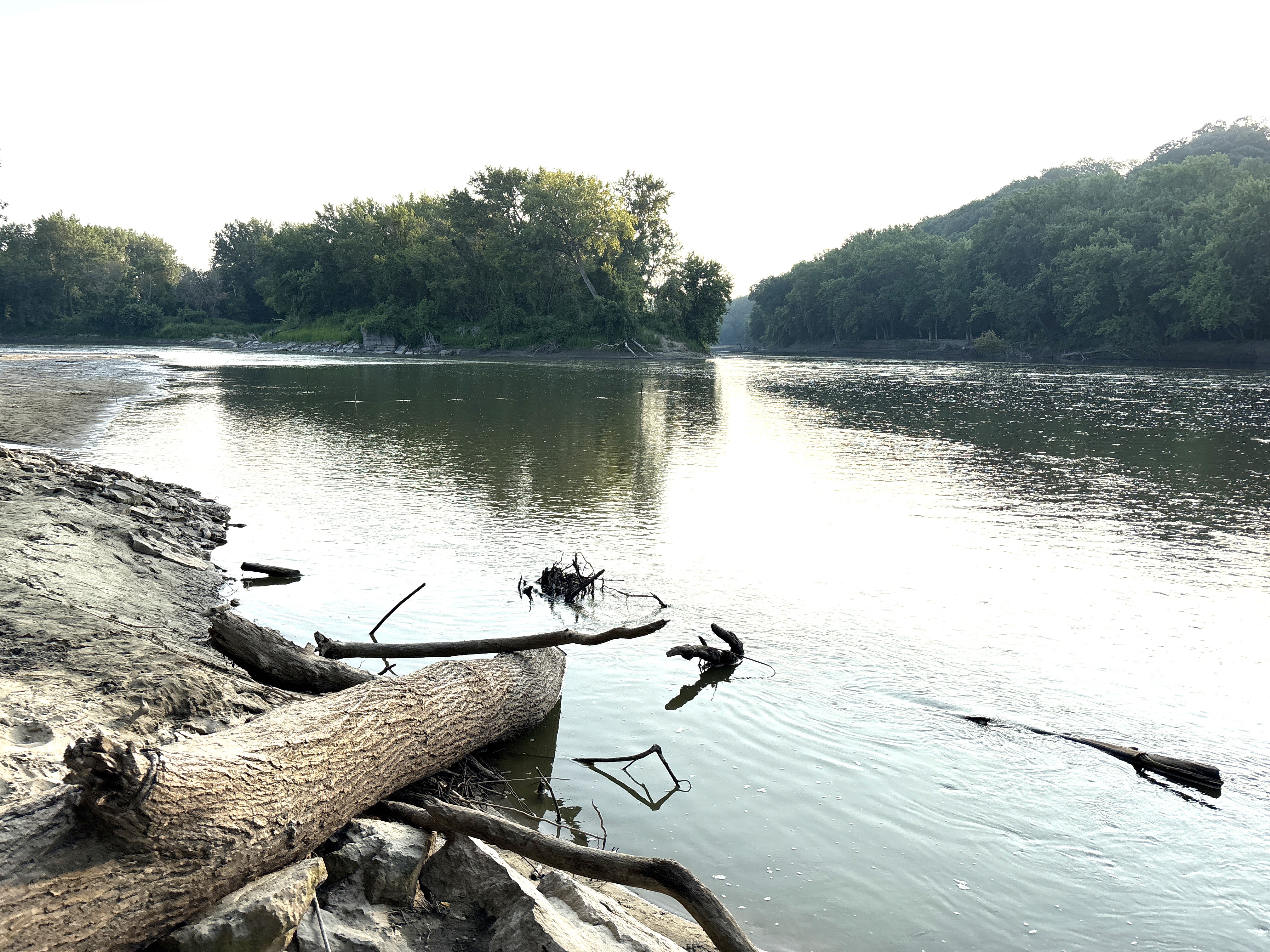
Fishing the Minnesota River

Yesterday, smoke from the wildfires in northern Minnesota and Canada drifted into southeastern Minnesota, producing some of the worst air quality Rochester has experienced this summer. The AirNow website showed an air quality index of 151 for Rochester—bright red on the map and categorized as “unhealthy.” Since the smoke appeared to be less severe farther west, I decided to spend the evening fishing around Mankato.

My target species were Silver Redhorse, Smallmouth or Bigmouth Buffalo, and Common Carp. I started at the Kiwanis Recreation Area on the Minnesota River just north of Mankato. Unfortunately, access to the river was difficult because of the steep banks. After finding a fishable spot and waiting about twenty minutes without a bite, I moved on.

My next idea was to fish below Rapidan Dam, but that turned into a wild-goose chase. The dam area has been heavily impacted by flooding and is now being decommissioned, leaving no practical fishing access.

I finally settled on Sibley Park, a beautiful park in Mankato situated near the confluence of the Blue Earth and Minnesota Rivers. Once I finally got a line in the water, I began catching several small fish that I initially assumed were Yellow Bullheads. After taking a closer look, however, I began to have doubts. The fish seemed much too sleek and handsome for a bullhead, and I wondered if they might instead be juvenile Channel Catfish. After posting a photograph to iNaturalist, my suspicion was confirmed.

Channel Catfish (juvenile)
Minnesota River, Sibley Park

The most obvious field mark that distinguishes the fish I caught from a Yellow Bullhead is the deeply forked tail. Bullheads have a square or only slightly rounded tail, whereas Channel Catfish have a distinctly forked one. The fish also had a long, streamlined body, a relatively small and narrow head, silvery-blue coloration with an olive back, and faint dark spotting along the sides, all features consistent with a juvenile Channel Catfish.

What struck me most was how different these juvenile Channel Catfish looked from the large adults I had caught previously. Large channel cats develop broad heads, heavy jaws, and thick barbels that give them an impressive, rugged appearance. In contrast, these young fish were remarkably elegant. Their streamlined bodies, forked tails, and subtle iridescence created flashes of blue, silver, and gold in the sunlight.

Although the Channel Catfish was not a new species for my list, the outing was nevertheless satisfying. Catching these juvenile fish gave me a deeper appreciation for a species I thought I already knew. Having previously caught only larger Channel Catfish, I had never really noticed how sleek, elegant, and attractive the young fish can be.

Species #31 and 32: Lake Sturgeon and Flathead Catfish

It has been quite a while since I last caught a new fish species. My previous addition to the list was a Golden Redhorse on July 29. Fortunately, that drought ended today.

To improve my chances of catching a Lake Sturgeon (a new fish for me), I hired a guide named Jarrad. Jarrad told me he has been guiding anglers on the Mississippi River and surrounding waters for 37 years. His business is called Rutting Ridge Outfitters. He helped me catch the Lake Sturgeon I was targeting, was extremely friendly, and taught me a number of things along the way.

Lake Sturgeon

Since we were scheduled to meet about 10 miles north of Winona at 6:30 a.m. (an hour drive from Rochester), I got up at 4:00 a.m. to make sure I arrived on time. I pulled in at about 6:20 and found Jarrad already there and ready to launch his boat.

I had envisioned a long boat ride to our fishing destination, but it turned out to be almost within sight of the launch. We fished near the upper end of Mississippi River Pool 5A, just below U.S. Lock and Dam No. 5. Jarrad explained that sturgeon like this area because food is constantly being carried downstream from the pool above the dam.

Although I was excited about the prospect of catching a Lake Sturgeon, I also felt a little apprehensive. The forecast called for temperatures above 90°F, and I have experienced heat exhaustion—and possibly heatstroke—a couple of times in my life.

One incident occurred many years ago when my brother, his best friend, my best friend, and I went hiking in Canyonlands National Park in Utah. We lost our way and ran out of water before finally finding our way back to our vehicles. The nearest town, Moab, was about 60 miles away. By the time we got there, I was severely overheated. When I reached the hotel, I had dry heaves, but fortunately I recovered without lasting effects.

As it turned out, today was every bit as hot as predicted. There was virtually no wind and not a cloud in the sky. We managed by wearing hats, drinking plenty of water and Gatorade, and periodically soaking our shirts in the river and putting them back on. Even so, we decided to call it a day at about 11:30 a.m.

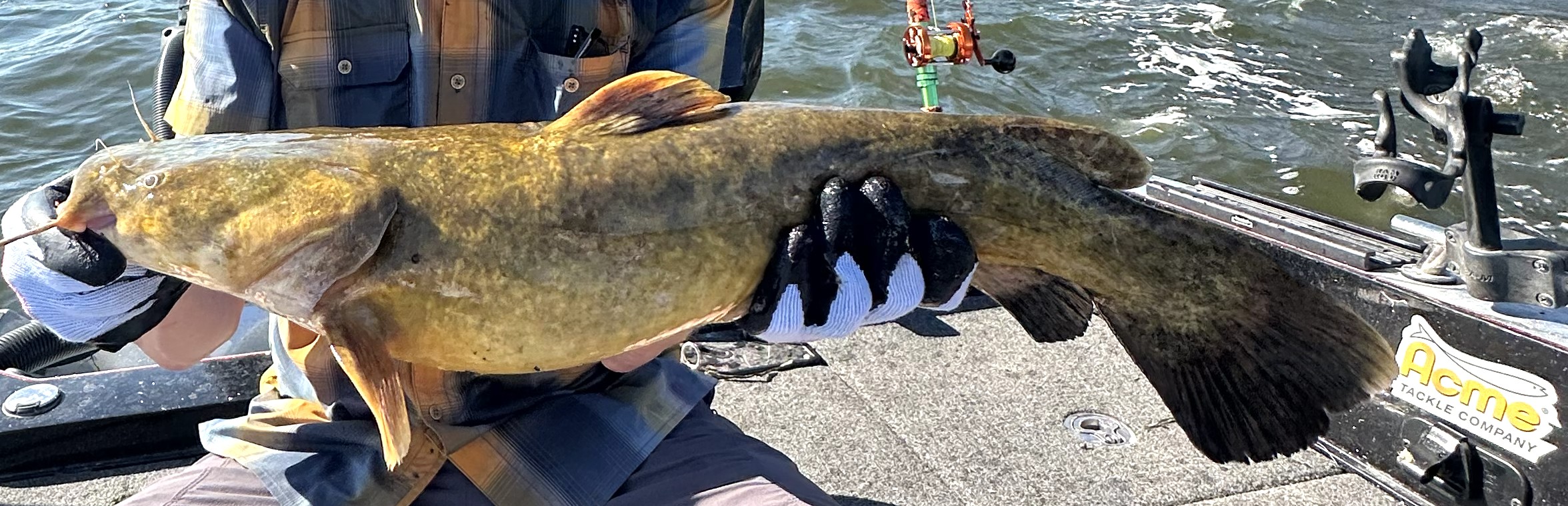
Our first Lake Sturgeon took only about 15 minutes to catch after we positioned ourselves near the dam. As the morning progressed, we landed three more Lake Sturgeon, two Flathead Catfish, and three Channel Catfish. Two of the sturgeon were estimated by Jarrad to weigh a little over 30 pounds. Both the Lake Sturgeon and Flathead Catfish were new species for me.

The Flathead Catfish and Channel Catfish were impressive fish as well, probably weighing between 10 and 20 pounds. In fact, with the exception of the first sturgeon, all of the fish we caught were likely larger than any fish I had ever caught previously. Before today, I don’t think I had ever landed a fish weighing more than about five pounds.

Flathead Catfish
Channel Catfish

Incidentally, Jarrad had recently suffered a painful accident. About a week before our trip, while we were making arrangements, he sent me a photograph showing stitches in two fingers on his right hand. He had accidentally cut off the tips of those fingers with a table saw. When I asked what had happened, he replied, “Table saw. The saw won.”

He is still learning how to adapt to tying knots and baiting hooks with his injured hand but appears to be doing very well with that. I ended up helping put quite a few nightcrawlers on the hooks throughout the day to be helpful.

I learned a lot from Jarrad. The fishing rig itself was entirely new to me. We used very heavy braided line—he didn’t specify the pound test, but I would guess it was somewhere between 50 and 100 pounds—along with an 8-ounce pyramid sinker and a massive 8/0 circle hook threaded with two or three nightcrawlers.

As I mentioned in an earlier post, fish essentially hook themselves on circle hooks. Unlike traditional hooks, there is no dramatic hook set. The fish takes the bait, turns away, and the hook catches in the corner of its mouth.

Another first for me was using a baitcasting reel. Most of the casting was done by Jarrad because he knew exactly where he wanted the bait positioned. I suspect he may also have been a little concerned that I would create a spectacular backlash, since I had never used a baitcasting reel before.

However, he did teach me the basics, and I probably made five casts on my own. He explained that you keep your thumb on the spool during the cast and then lightly feather the line as it leaves the reel to prevent tangles. He also showed me how to properly hold large fish for photographs: one hand on the tail and the other supporting the fish near the pectoral fins.

Overall, it was a very satisfying day. I added two new species to my list, caught several of the largest fish of my life, and learned a number of new things about fishing.

Fishing Near Home

In case you haven’t read any of my other posts, I live in Rochester, Minnesota. I’m a soon‑to‑be fully retired molecular pathologist. Over the years I developed genetic tests for diagnosing and guiding treatment for cancer—one example is a urine‑based test for detecting bladder cancer. With my team, I implemented these assays and signed them out to help oncologists and other physicians care for their patients. It’s been a rewarding career, but now it’s time to pursue my many hobbies, one of which is fishing.

I eventually hope to fish in places like Florida, Texas, and California to reach my 100‑species goal, but most days I’m content fishing close to home. Yesterday I woke up at 5 a.m. to get out before the heat—and because the early bird gets the fish.

I started in the tailwaters below the Silver Lake dam and caught a White Sucker, a Bluegill, and three Bullheads (likely black; next time I’ll check the barbel color more carefully to be sure). After that I headed to Foster Arend Lake to fish from the pier. Even at 8 a.m. it was crowded and already hot with no shade. I caught a good‑sized Bluegill, then decided to look for somewhere quieter.

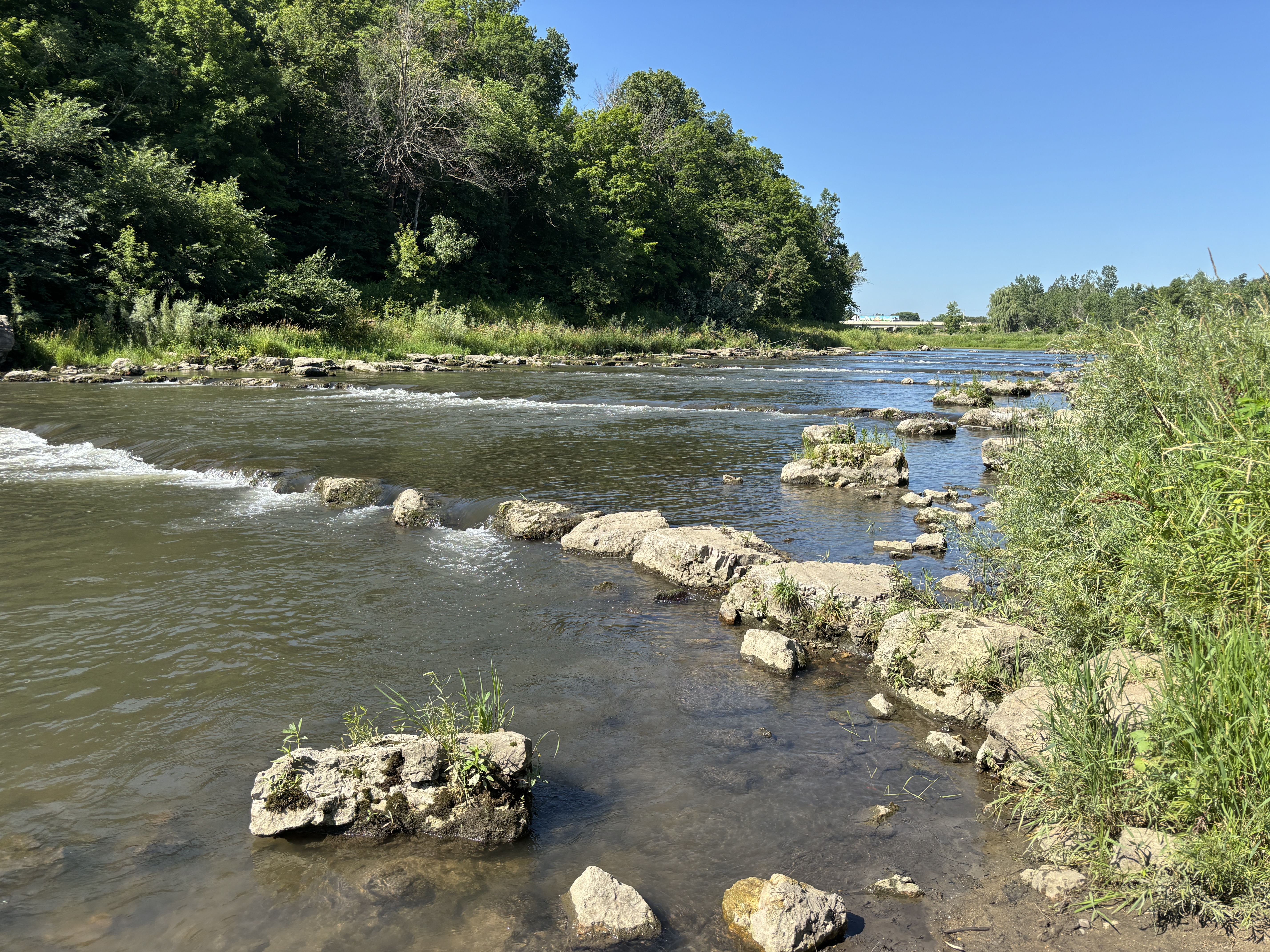
That led me to explore a few places I’d never fished before. I drove north to Oronoco, a town of about 2,000 people roughly ten miles north of Rochester. The Middle Fork of the Zumbro River runs through town. In the 1930s a dam was built to create Lake Shady, a recreational impoundment upstream of downtown. The dam was heavily damaged by a flood in September 2010, and instead of rebuilding it, the city chose a river restoration approach—replacing the dam with a series of rock‑arch rapids. The project was completed in the mid‑2010s and even received engineering awards in 2019.

Middle Fork Zumbro River

Once I arrived, I found the area promising—potentially a good spot for redhorse. I used my usual rig: 6 lb line, a 1/4‑ounce egg sinker, bead, barrel swivel, about 15 inches of monofilament leader, and a size 8 hook. After about five casts I felt what seemed like a snag, but it turned out to be a nice sized Golden Redhorse. I would have stayed longer, but the heat was building and the morning was getting late, so I headed home.

Golden Redhorse

On the walk back to my car I noticed a beautiful Cardinal Flower—probably my favorite wildflower—growing along the path. A perfect ending to an enjoyable morning of fishing.

Cardinal Flower (in front) and Wild Bergamot (in back)

Why I Don’t Own a Boat

My wife tells me not to tell this story.

It’s embarrassing, but I’ve always had a sense of humor about my mistakes, so I’m going to tell it anyway. It also helps explain why, in my quest to catch 100 different fish species, I do most—if not all—of my fishing from shore.

This happened a long time ago, in 2001. I was about 42 years old, and my son was 11. Within the previous year, I had purchased a new Ford F-150 pickup and a new boat, an 18-foot Rinker ski boat. I asked my son if he wanted to spend a weekend fishing in the Brainerd Lakes area of Minnesota.

He said yes, so we packed up and headed north. I think we stayed in a hotel on Friday night and planned to return home Saturday evening. I can’t remember the exact lake. There are so many beautiful lakes in that area, and after 25 years they all tend to blend together.

We launched the boat and spent most of the day fishing. Unfortunately, the fish were not cooperating. By mid-afternoon we had not had a single bite and decided to call it a day.

That decision turned out to be the easy part. The boat ramp was extremely steep. As I started pulling the boat out of the water, I heard a scraping sound. From the boat, my son immediately started yelling: “Dad! Stop! Stop! Stop!” I instantly realized my mistake. I had forgotten to trim the outboard motor up before pulling the boat out. I put the truck in park, got out, and went back to the boat to raise the motor. Unfortunately, instead of trimming the motor up, I somehow trimmed it down. That was all it took. The truck’s parking mechanism disengaged, and in an instant the truck began rolling backward down the steep boat ramp toward the lake. I jumped off the boat and made a desperate attempt to get back into the cab and put the truck in park. I didn’t make it. Instead, I fell hard onto the concrete ramp. Fortunately, I missed going under the wheels. Had things been only slightly different, this story might not be getting written. I injured my arm badly in the fall while the truck continued its journey into the lake. The truck ended up window‑deep in the water. Once water gets into the circuitry, the insurance company considers the vehicle totaled, and that’s exactly what happened. The boat sustained damage as well, although it was eventually repaired.

If there is anything funny about the story, it was what we found when we finally opened the driver’s door. About seven sunfish had somehow made their way into the cab of the truck. Those were the only fish we caught all day.

Because of my arm injury, an EMT was called. One of the EMTs was extraordinarily kind and put us up for the night since finding a hotel on short notice would have been difficult.

The whole experience was stressful at the time, but it has become one of those stories that gets funnier with each passing year.

What may surprise you is that I kept the boat for another five years. During that time, I had many enjoyable fishing and water-skiing adventures with both my son and daughter. Eventually, however, we sold it. That reminds me of the old saying that the two best days of a boat owner’s life are the day he buys the boat and the day he sells it.

Now that I’m 67 years old and even less confident in my boating abilities than I was at 42, I’ve decided that shore fishing suits me just fine. I don’t miss launching boats, loading boats, maintaining boats, insuring boats, or writing checks for new boats. I’ve also discovered that rivers often hold a greater variety of fish species than lakes, which is ideal for someone trying to reach 100 species.

That’s not to say I’ll never fish from a boat again. If a particular species requires one, I’ll gladly hire a guide or rent a boat.

Species #29: Shorthead Redhorse

Woke at 5 a.m. to head back to Northfield below Ames Dam, hoping to catch a Redhorse species—though I would have gladly taken a Bigmouth Buffalo or Carp. I was set up and fishing by about 8 a.m.

I used a simple bottom rig: 6‑lb monofilament main line and leader, a ½‑ounce sliding egg sinker, barrel swivel, and initially a size 8 hook (later switching to a size 10).

After about 20 minutes, I landed a Freshwater Drum. Soon after, I hooked what appeared to be a Redhorse but lost it at the shoreline. The same sequence repeated—another drum, then another lost Redhorse. At that point, I downsized from a size 8 to a size 10 hook to see if it would improve hookups.

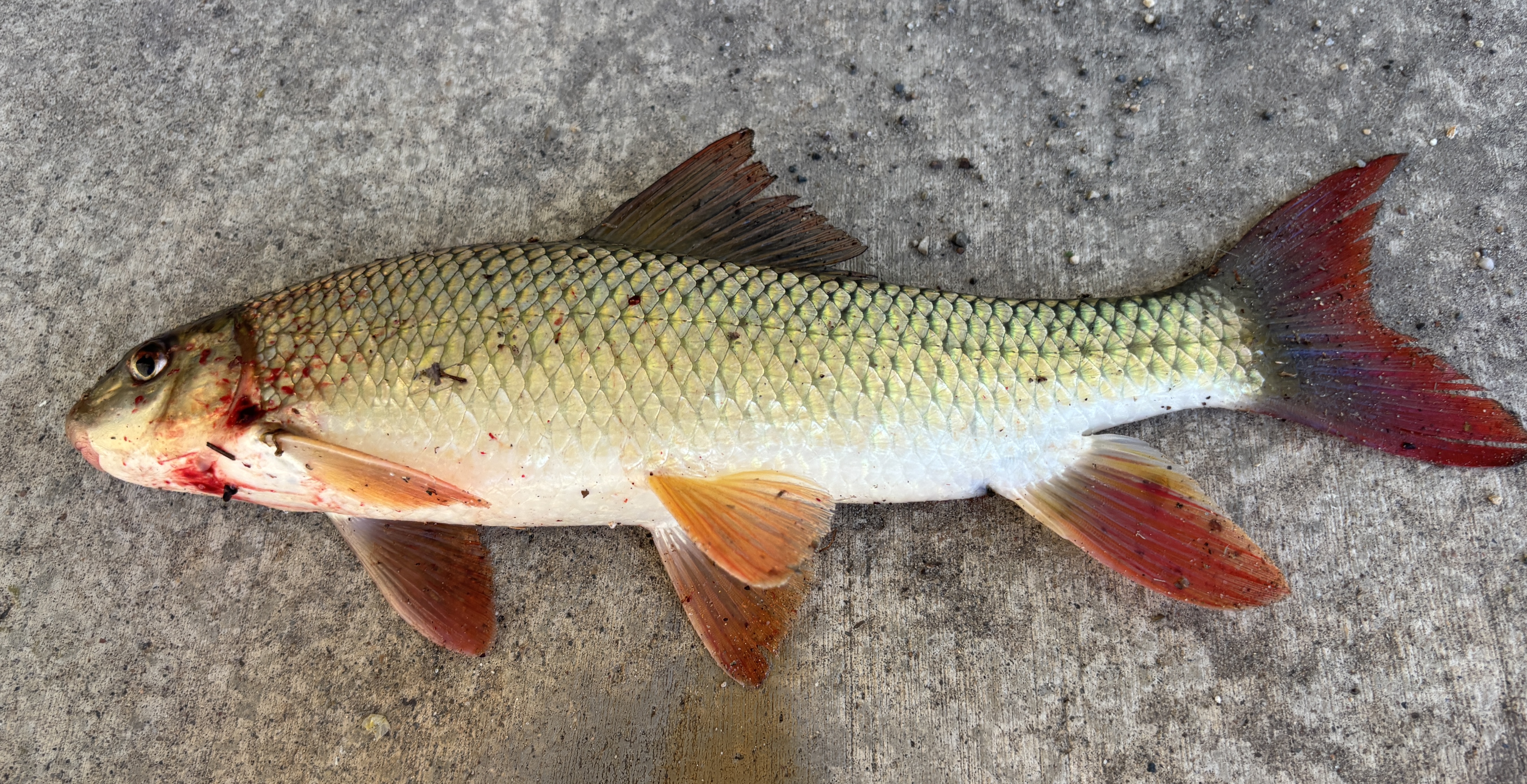
That adjustment paid off. I was thrilled to land my first Redhorse—specifically, a Shorthead Redhorse. Interestingly, it didn’t put up much of a fight initially, but as it neared shore, it surged with surprising strength.

Shorthead Redhorse

Unfortunately, the fish was gut‑hooked and visibly bleeding. I chose not to attempt hook removal; instead, I cut the line and released it. My understanding is that cutting the line is generally the best option in these situations, especially when there is bleeding. Attempting to remove a deeply embedded hook in species like redhorse—whose gill arches are delicate and whose throats are narrow—can cause far greater damage.

Research supports this approach. Once a hook passes beyond the tongue pad, removal often leads to tearing of tissue or injury to the esophagus or gill arches. Cutting the line avoids additional trauma. In many cases, the hook will corrode, become encapsulated by tissue, or eventually pass. Studies in similar species (catfish, suckers, carp) show significantly higher survival rates when anglers cut the line rather than attempt removal.

Redhorse are especially prone to gut‑hooking because of how they feed. They inhale food rather than striking it, feed head‑down so the hook slides inward easily, and produce a very subtle bite that’s easy to miss—particularly when using worms, one of their preferred foods.

The fish itself was striking. The fins were a vivid, almost glowing red—peak June coloration. Shorthead Redhorse are among the most beautiful freshwater fish in Minnesota. This coloration comes from carotenoid pigments acquired through their diet, with intensity enhanced by spawning‑season hormones.

These bright red fins likely serve several purposes:

  1. Spawning signal – helping fish locate each other in often murky water
  2. Species recognition – subtle differences distinguish species within the genus
  3. Health indicator – brighter coloration often reflects a well‑fed, healthy fish

This one clearly checked all three boxes—the most visually striking fish I’ve caught in some time.

Which Has Greater Fish Species Diversity in the US, Rivers or Lakes?

The fact that I prefer fishing from shore has nudged me toward rivers—and that, in turn, led to an unexpected realization: rivers seem to hold an extraordinary diversity of fish. That observation made me wonder whether rivers actually harbor more species than lakes. It turns out they do—and it’s not even close.

So why is that? The short explanation is simple: rivers create more ecological niches per mile than lakes, and niches create species. This reflects a broader ecological principle. Ichthyologists have shown that lotic systems (flowing water) tend to support greater species richness at local scales than lentic systems (still water).

Again, why is that? Rivers generate a remarkable range of habitats—riffles, runs, pools, backwaters, floodplains, estuarine transitions, springs, tributaries, and headwaters. Each of these environments supports different species. In addition, rivers contain fine-scale microhabitats (eddies, seams, root wads, undercut banks) that further expand ecological opportunities. Lakes simply lack this degree of structural complexity.

Rivers also function as connected networks spanning large geographic areas. This allows for dispersal, isolation, recolonization, and ultimately speciation and helps explain why entire groups—darters, shiners, redhorse, and suckers—are predominantly riverine and have diversified into dozens (or hundreds) of species. Lakes, in contrast, are more like isolated bowls: excellent for stability, but less conducive to generating new species.

This pattern is especially evident in the southeastern United States. River systems such as the Tennessee, Cumberland, Mobile, and Apalachicola basins contain the highest freshwater fish diversity in North America—and among the highest in the world outside the Amazon. These are river systems, not lake systems.

So how large is the difference? Of the roughly 800+ freshwater fish species in the United States, the vast majority are associated with rivers and streams. Many are endemic to single watersheds. True lake-specialist species are relatively rare (for example, some ciscoes and pupfish), numbering only a few dozen. By contrast, river-dominated groups are extraordinarily diverse: redhorse (15+ species), darters (200+), minnows (300+), suckers (70+), and madtoms (30+).

None of this diminishes the importance of lakes—they excel in other ways. Lakes support high biomass, offer stable environments, and sustain large, iconic predators such as walleye, pike, and lake trout. They are also central to recreational fisheries. But they are not the primary engines of speciation.

If your goal is species diversity, rivers and streams are the heart of freshwater biodiversity in the United States. Lakes are wonderful—but rivers are where evolution does some of its most creative work.

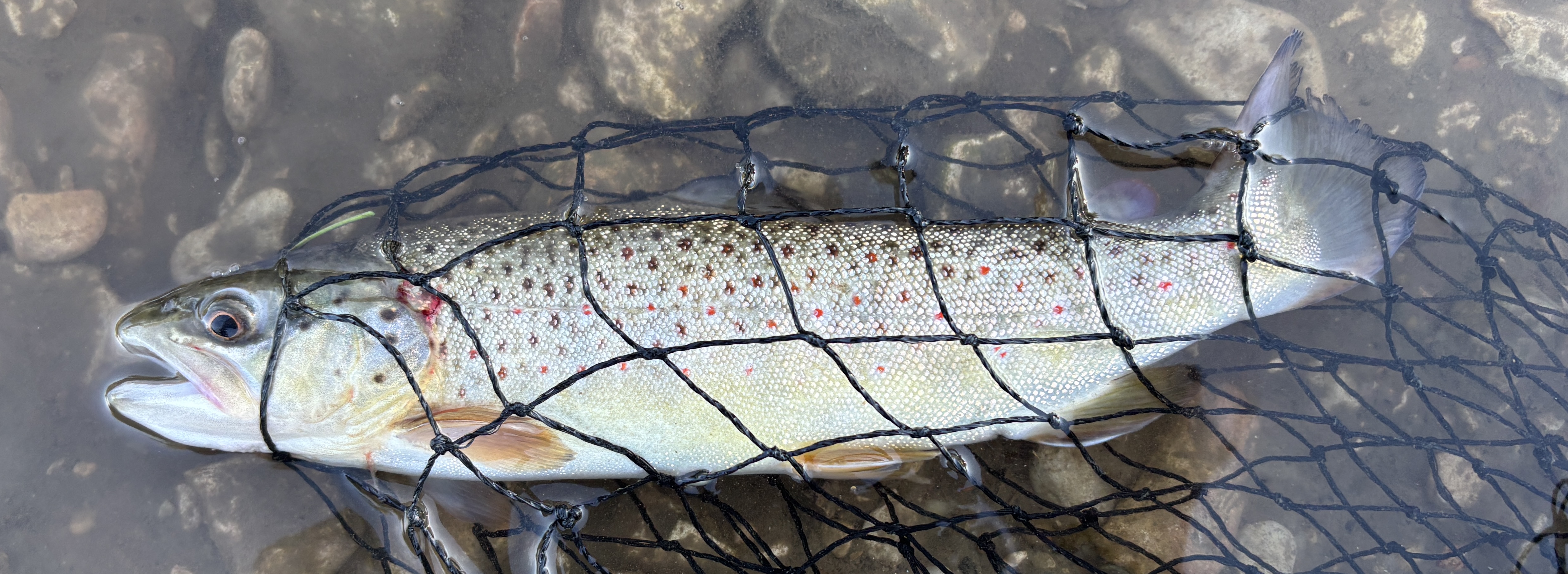
Species #28: Brown Trout

I woke up at 4:30 a.m. and headed back to the Root River in Preston, hoping this would be the day I landed a Brown Trout (Salmo trutta). It took about 45 minutes to get there, and I was fishing by 6:00 a.m. It was a little chilly, but a really nice morning—sun, scattered clouds, almost no wind.

This stretch of the Root River is fairly narrow and probably not very deep. The night before, I’d seen some kids swimming in it, and they were often able to stand with their heads out of the water. I’d guess it’s about 30–40 feet across in most places. Still, it clearly holds fish. On earlier trips I had already caught Rainbow Trout, Common Shiner, Creek Chub, and White Sucker.

I started out throwing a couple of small inline Panther Martin spinners. I should have written down the exact size and colors, but didn’t. One was all silver, and the other had green, red, and silver—at least I think that’s what it was. Probably the next-to-smallest size. I made around 40 casts without a single bite. Eventually I decided that was enough persistence for one lure.

The water looked a bit murky, probably from heavy rains the day before, and I began to suspect the fish just weren’t seeing the spinners very well. Or possibly they were seeing them and choosing to ignore them—always another possibility. Either way, I switched back to the bottom rig that had worked well on my last two trips: 6 lb monofilament, 1/8 oz egg sinker, swivel, about a 12-inch leader, and a size 10 hook with a piece of worm.

The action was pretty slow, but then I finally caught a Brown Trout. Not a huge one, but a nice fish and, more importantly, a new species for me. I posted it to iNaturalist and, I’ll admit, kept checking back waiting for confirmation. About eight hours later someone confirmed that it was a Brown Trout. I also picked up another Common Shiner along the way.

Brown Trout

After that, I switched things up and headed over to the Mississippi River to try for Bowfin. That’s a completely different game—different rod, different rig, different mindset. No luck this time, but that’s probably a story for another day when I actually catch one.

With the Brown Trout, I’ve now completed the trout “triumvirate”: Rainbow, Brook, and Brown. I’ve caught Rainbow in Minnesota and Washington, Brook in Washington, and now Brown in Minnesota. Next on the list are Lake Trout, Splake, and Tiger trout—because apparently there is always another fish to chase, and apparently I am fine with waking up at 4:30 a.m. to do it.

Species #27 Common Shiner

I went to the South Fork of the Root River in Preston, Minnesota this afternoon and evening hoping to catch a Brown Trout for my species list. I used the same bottom rig I had the other night, baited with a bit of worm. Once again, I ended up with something different—LOL. I landed a nice Rainbow Trout and hooked a couple more fish that I couldn’t bring in. One of those might have been a Brown Trout, but I can’t say for sure. I stayed from about 5:30 to 8:30 p.m., getting occasional bites, though I missed most of the hooksets. Just as I was about to call it a night, I caught one last fish that I suspected might be something new, but I wasn’t sure what it was.

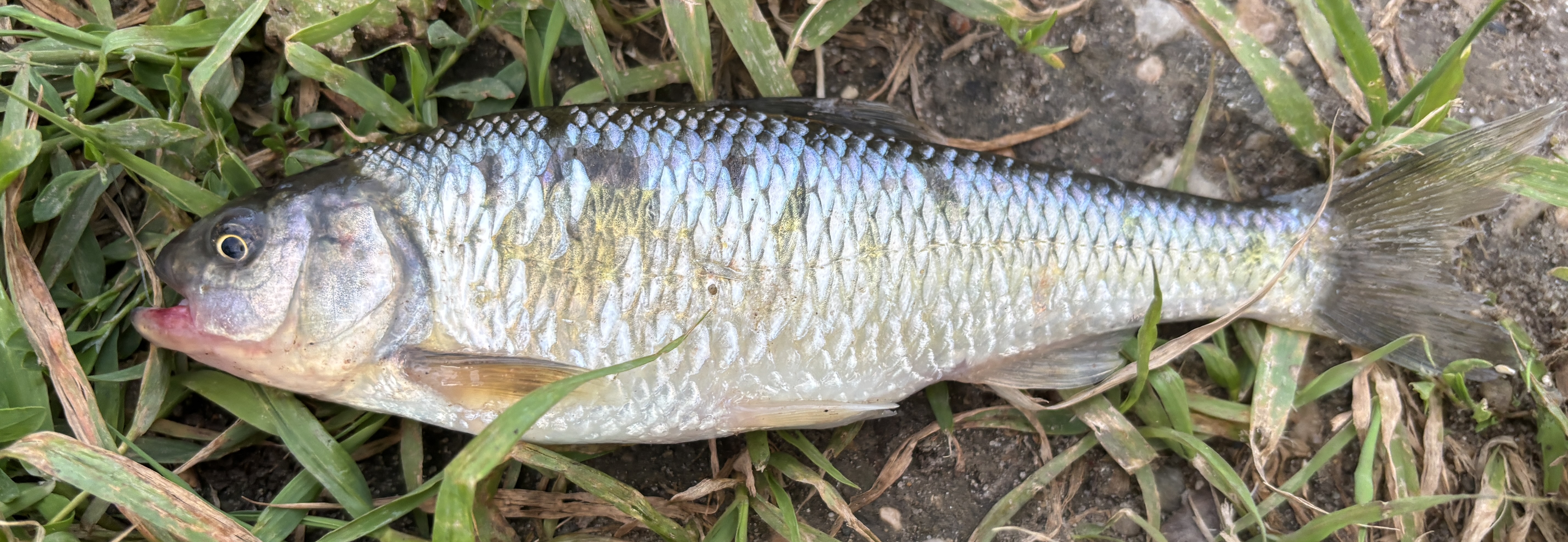
Common Shiner

iNaturalist identified it as a Common Shiner, which immediately made me wonder what exactly that was. A little research cleared things up. Shiners are part of the Minnow family (Cyprinidae), the largest family of freshwater fish in North America. The Common Shiner (Luxilus cornutus) is one of the more widespread species and is typically found in clear streams with moderate current—exactly the kind of water I was fishing. They usually have a silvery body with a darker back and tend to grow to about 2–6 inches. The one I caught was right around 6 inches.

I also learned that while all shiners are minnows, not all minnows are shiners. “Minnow” is a broad term that includes shiners, daces, and chubs, among others, while “Shiner” generally refers to these small, silvery, often schooling fish. Common shiners are a bit more robust than some of the other shiner species and can be an important forage fish for larger predators. Overall, it was a fitting and interesting catch for that stretch of river—even if I’m still looking for that Brown Trout.


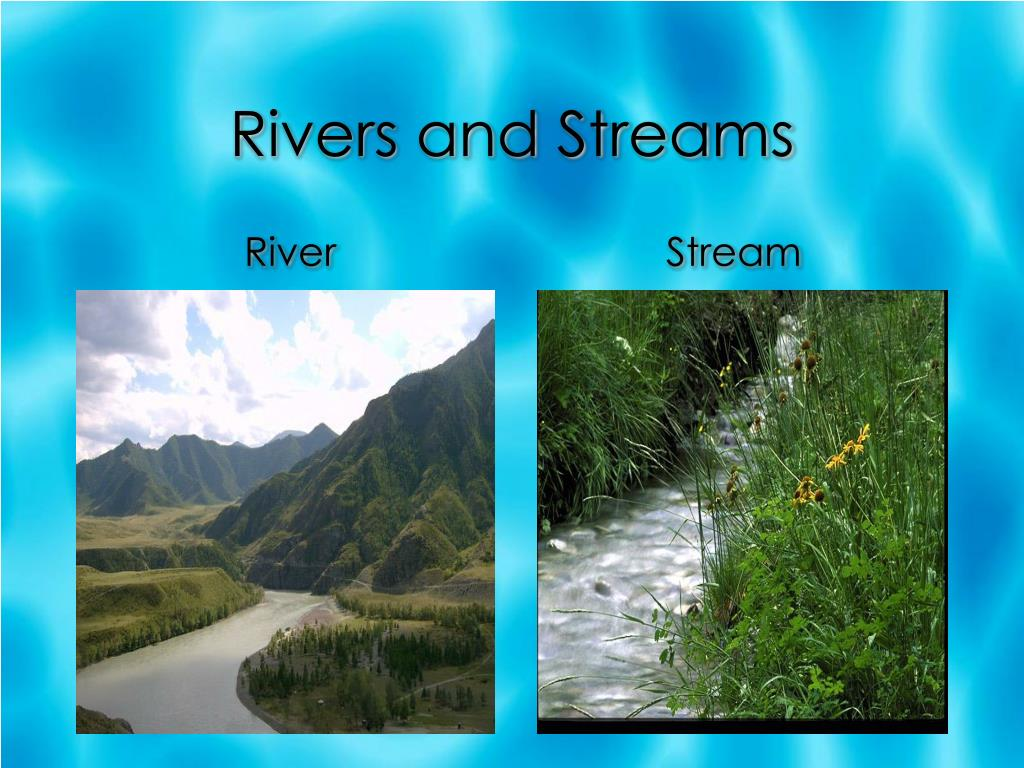
River vs. Stream: What’s the Real Difference?

Have you ever wondered whether there’s a real difference between a river and a stream? While fishing one day, I found myself asking exactly that question. My initial thought was that a river is just a bigger stream. That’s partly true—but it’s a little more complicated than that.

In the strictest sense, stream is a general term for any flowing body of water, while a river is simply a large stream. In other words, all rivers are streams, but not all streams are rivers. The point at which a stream becomes a river isn’t fixed—it’s somewhat subjective and often depends on regional usage.

A useful analogy is roads: a stream is like any road, from a small street to a highway, whereas a river is more like a major highway. An even better analogy, though, is a tree. Small headwater streams are like the tiniest twigs; as they join together, they form larger branches, and eventually a main trunk. In this sense, a river is the trunk of the tree, fed by an entire network of smaller branches upstream.

Hydrologists take a more systematic approach using the Strahler stream order system. In this system:

  • 1st-order streams are the smallest channels with no tributaries and are often headwaters.
  • 2nd-order streams form when two 1st-order streams meet.
  • 3rd-order streams form when two 2nd-order streams meet, and so on.

Using this classification:

  • Low-order streams (1–3) are what most people think of as streams, creeks, or brooks.
  • Mid-order streams (4–6) are transitional and are often locally called rivers.
  • High-order streams (7+), such as the Mississippi River (around 10th order), are large rivers.

So, who cares?

For anglers, this actually matters. Stream order correlates strongly with habitat type, water conditions, and fish communities. In many cases, the size and order of a stream are good predictors of the kinds of fish you’ll find there:

  • 1st–2nd order streams (tiny headwaters):
    Cold, shallow, and shaded; typically home to small trout and minnows.
  • 3rd–5th order streams (small rivers/creeks):
    More stable flow with moderate depth; commonly hold trout, smallmouth bass, and panfish.
  • 6th-order and higher (large rivers):
    Deeper, slower, and warmer waters; support species like walleye, catfish, pike, and largemouth bass.

As stream order increases, you generally move from small, cold-water species to larger, warm-water fish.