About a month ago, I emailed a friend a photograph of the impressive Lake Sturgeon I had caught with a guide on the Mississippi River in mid-July.
His response was immediate:
“Fun to catch, but damn are they ugly fish!!!! You should try a muskie guide on Leech Lake.”
And so I did.
The muskellunge, or muskie (Esox masquinongy), is the largest member of the pike family and one of North America’s most sought-after freshwater game fish. Often called the “fish of 10,000 casts,” muskies are relatively rare and notoriously difficult to catch. As apex predators, they can exceed 50 inches in length and weigh more than 40 pounds in Minnesota waters.
After a little research, I booked a guided trip with Luke Swanson of Livin’ the Dream Guide Service. I also invited my friend Jesse Hoekstra, a family friend and work colleague, and his son Briar to join me.
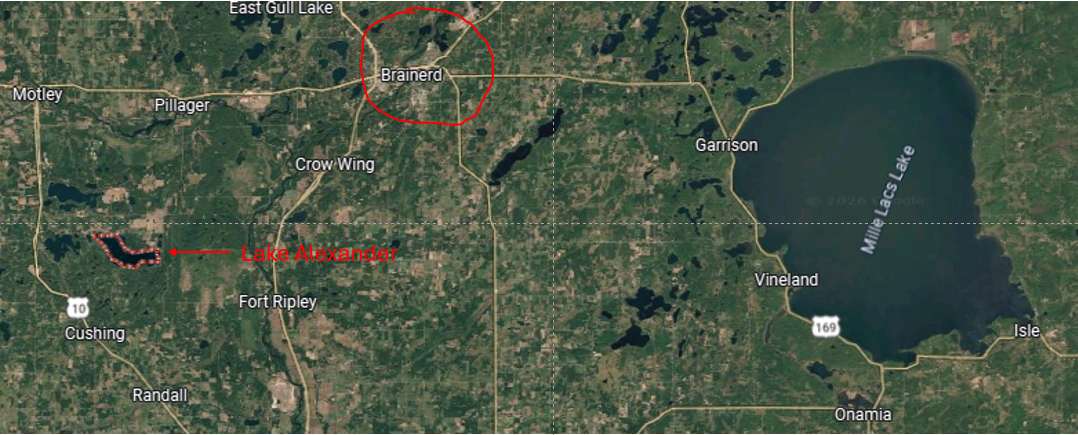
I drove to Brainerd the evening before and spent the night at a Holiday Inn Express. My alarm went off at 4:45 a.m. so I could meet Luke at Alexander Lake, about thirty minutes southwest of Brainerd, at 6:00 a.m.
Unfortunately, the day got off to an inauspicious start.
About five minutes from the landing, a deer suddenly darted into the road. I had no time to avoid it. The collision completely destroyed the front bumper of my car.
I pulled over to inspect the damage. The bumper looked terrible, but the vehicle appeared drivable. Since there was not much I could do about it before dawn, I climbed back in and continued toward the lake.
When I arrived, Jesse and Briar were already in the boat with Luke.
“Sorry I’m late,” I said. “I hit a deer about five minutes back.”
They expressed their sympathy, and we all agreed that the bumper could wait until after the fishing trip.
We had muskies to chase.
Luke was a friendly and colorful character who looked to be in his mid-thirties. He explained that he spends June through December in Minnesota and January through May in Florida near Fort Myers. During the Minnesota season he guides for muskies, walleyes, and smallmouth bass. During the winter and spring he guides primarily for tarpon in Florida.
According to Luke, tarpon are the greatest fish in the world to catch.
“Nothing else compares,” he told us.
The weather was pleasant for late August, about 60 degrees with mostly cloudy skies and only a light breeze. It felt a little chilly at first, but it warmed steadily as the morning progressed.
Luke supplied all the rods, reels, and tackle. Our first lesson involved learning how to cast and retrieve muskie lures. These were not the tiny spinners and jigs I was used to. Most were eight to ten inches long and looked more like small fish than lures.
Luke also taught us the famous figure-eight maneuver beside the boat. Apparently, muskies often follow a lure all the way to the boat without striking, and abruptly lifting the lure from the water can cost an angler a fish. Instead, experienced muskie anglers sweep the lure in large figure-eight patterns next to the boat in hopes of provoking a last-second strike.
After about thirty minutes of practice, Luke showed us the technology that would help us find fish.
His Garmin sonar unit was astonishing. It scanned far ahead of the boat and well off to each side, allowing him to locate schools of baitfish and, occasionally, the large predators we were seeking. As we cruised around the lake, he pointed out schools of perch and crappies on the screen. Every now and then a much larger mark would appear.
“That’s probably a muskie,” he would say.
When Luke spotted a fish he liked, he would quietly maneuver the boat to a position about fifty feet in front of it. One of us would move to the bow and cast toward the fish while Luke monitored its movements on the sonar.
Then the coaching would begin.
“Twitch.”
“Pause.”
“Speed it up.”
“Now slow it down.”
Everything depended on how the muskie reacted.
We rotated turns, and Briar was first up.
After about thirty minutes of searching, Luke spotted what he felt was almost certainly a muskie. Briar stepped to the front of the boat and made his cast.
Then, seemingly within seconds, he hooked a fish.
“Keep reeling!” Luke shouted. “Don’t stop reeling!”
Briar followed instructions perfectly.
I don’t remember exactly why continuous reeling was so important, but Luke made it very clear that stopping was not an option.
After a short but spirited fight, the fish came alongside the boat and Luke skillfully netted it.
We had our muskie.
The fish was a solid muskie and a beautiful fish. Briar had landed a muskie, and that was cause for celebration.
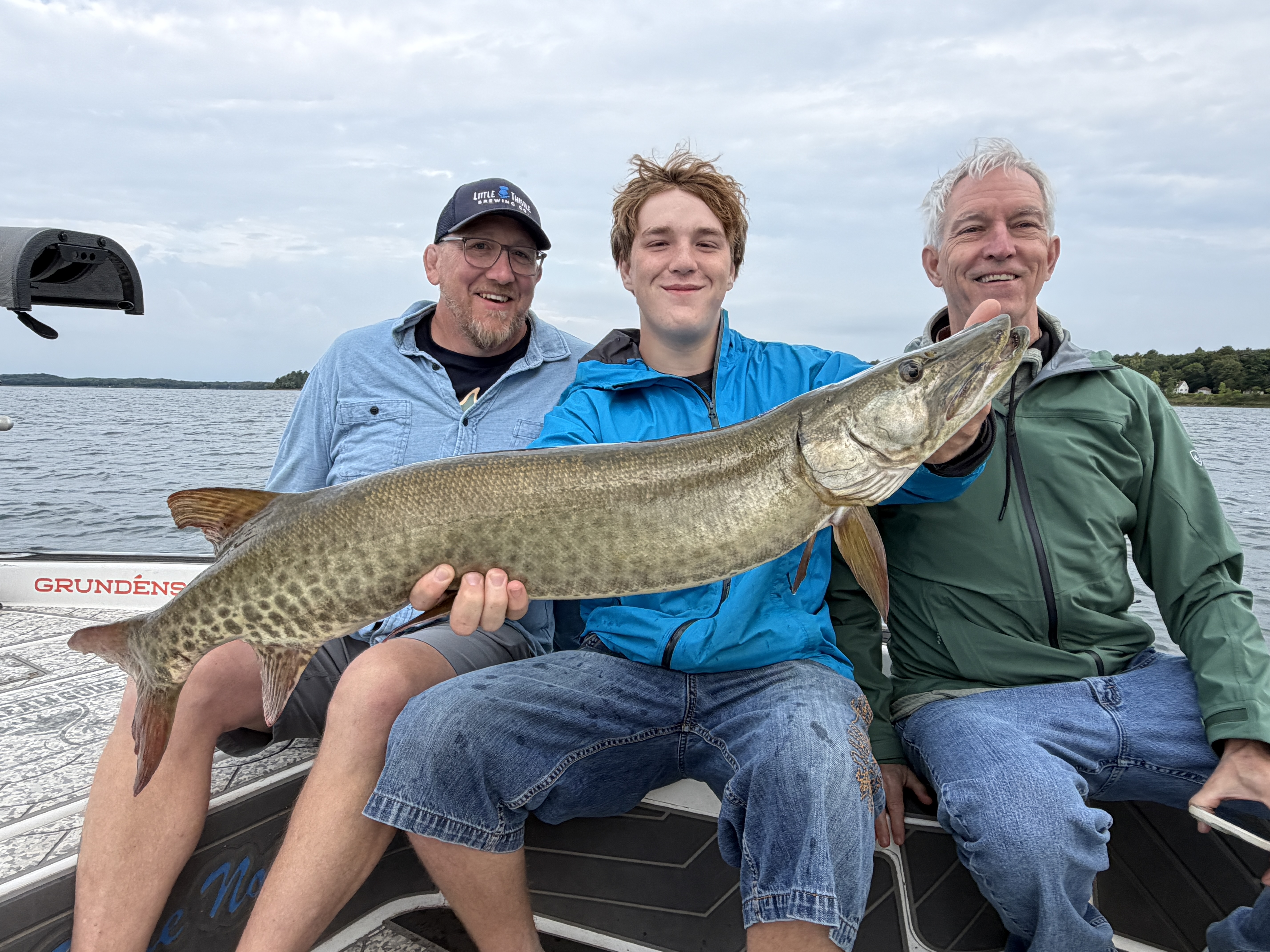
Luke took several photographs: Briar alone with the fish, Briar and Jesse together with it, and one with all three of us. Those photographs would become the lasting souvenirs of the trip.
It turned out to be the highlight of the day.
We continued searching the lake for several more hours but saw surprisingly few muskies. Eventually I got my chance.
Luke spotted another fish and positioned the boat. I made my cast and began working the lure back according to Luke’s instructions. Unfortunately, the fish showed little interest. Luke diplomatically informed me that my lure action needed improvement.
“Your twitches are too long and too quick,” he said.
He was undoubtedly correct.
The muskie remained unimpressed, and my opportunity disappeared.
Later Jesse had a chance at another fish but was similarly unsuccessful.
Luke told us that there are days when he does not catch a single muskie and exceptional days when his clients catch five or six. Considering the reputation of muskies as the fish of 10,000 casts, the fact that we landed one at all felt like a victory.
One of the pleasures of a guided fishing trip is the opportunity to talk with the guide, and Luke was an excellent storyteller.
One story involved an eleven-year-old boy who had fished with him several years earlier. The boy wanted badly to catch a muskie, but he lacked the strength and endurance needed to repeatedly cast heavy lures and retrieve them all day. Luke found himself doing much of the work.
The boy was frustrated and embarrassed.
“What do I need to do so I can do it myself next year?” he asked.
Luke told him he needed to get stronger and suggested a push-up program. Together they developed a plan and entered it into the boy’s phone. The goal was to gradually increase the number of push-ups performed each week.
The following year, when the boy returned as a twelve-year-old, he proudly told Luke that he had followed the plan and was now doing one hundred push-ups every day.
I found that pretty impressive.
Luke told another story about a young boy who wanted a pretty girlfriend. The boy asked for advice.
Luke told him, “Talk to every girl you meet, not just the prettiest one.”
He encouraged the boy to ask questions and show genuine interest in people. What classes are you taking? What do you like to do? What sports do you play?
According to Luke, if you learn how to talk comfortably with everyone, people will naturally enjoy being around you.
The boy later returned and informed Luke that his strategy had worked.
Fishing guides often spend long days talking with clients, and over time they accumulate a surprising amount of practical wisdom. Luke certainly seemed to have collected his share.
Around noon we headed back to the dock.
Once there, Luke, Jesse, and Briar helped me secure the remains of my front bumper well enough for the drive home. After thanking Luke for a memorable day on the water, we said our goodbyes and headed our separate ways.
I drove home without a muskie to add to my species list.
But Briar had caught one.
I had learned a great deal about muskie fishing, enjoyed the company of good people, survived a collision with a deer, heard some memorable stories, and spent a beautiful August morning on a Minnesota lake.
All things considered, it was a pretty good day.
 OneHundredFish