Woke at 5 a.m. to head back to Northfield below Ames Dam, hoping to catch a Redhorse species—though I would have gladly taken a Bigmouth Buffalo or Carp. I was set up and fishing by about 8 a.m.
I used a simple bottom rig: 6‑lb monofilament main line and leader, a ½‑ounce sliding egg sinker, barrel swivel, and initially a size 8 hook (later switching to a size 10).
After about 20 minutes, I landed a Freshwater Drum. Soon after, I hooked what appeared to be a Redhorse but lost it at the shoreline. The same sequence repeated—another drum, then another lost Redhorse. At that point, I downsized from a size 8 to a size 10 hook to see if it would improve hookups.
That adjustment paid off. I was thrilled to land my first Redhorse—specifically, a Shorthead Redhorse. Interestingly, it didn’t put up much of a fight initially, but as it neared shore, it surged with surprising strength.
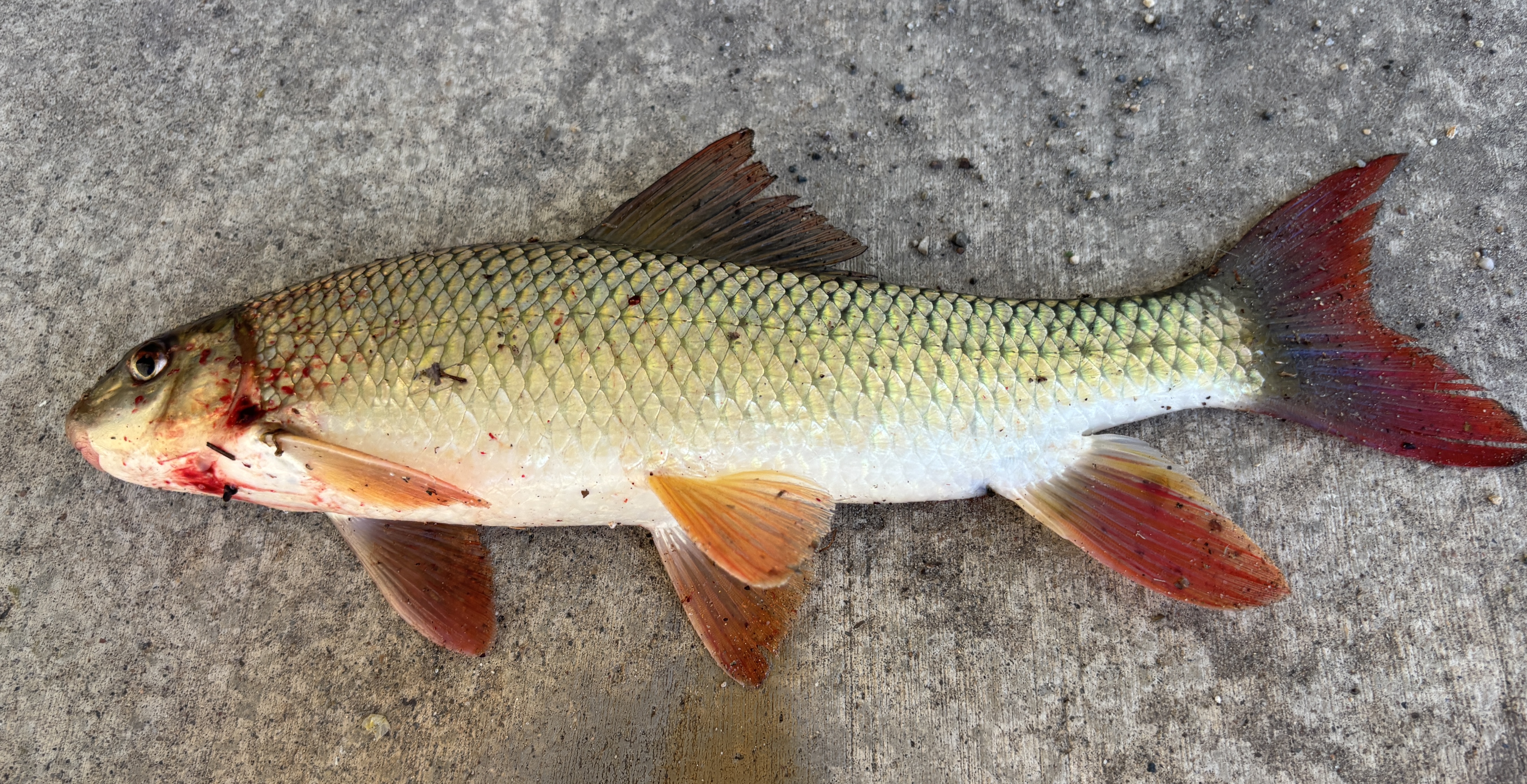
Unfortunately, the fish was gut‑hooked and visibly bleeding. I chose not to attempt hook removal; instead, I cut the line and released it. My understanding is that cutting the line is generally the best option in these situations, especially when there is bleeding. Attempting to remove a deeply embedded hook in species like redhorse—whose gill arches are delicate and whose throats are narrow—can cause far greater damage.
Research supports this approach. Once a hook passes beyond the tongue pad, removal often leads to tearing of tissue or injury to the esophagus or gill arches. Cutting the line avoids additional trauma. In many cases, the hook will corrode, become encapsulated by tissue, or eventually pass. Studies in similar species (catfish, suckers, carp) show significantly higher survival rates when anglers cut the line rather than attempt removal.
Redhorse are especially prone to gut‑hooking because of how they feed. They inhale food rather than striking it, feed head‑down so the hook slides inward easily, and produce a very subtle bite that’s easy to miss—particularly when using worms, one of their preferred foods.
The fish itself was striking. The fins were a vivid, almost glowing red—peak June coloration. Shorthead Redhorse are among the most beautiful freshwater fish in Minnesota. This coloration comes from carotenoid pigments acquired through their diet, with intensity enhanced by spawning‑season hormones.
These bright red fins likely serve several purposes:
- Spawning signal – helping fish locate each other in often murky water
- Species recognition – subtle differences distinguish species within the genus
- Health indicator – brighter coloration often reflects a well‑fed, healthy fish
This one clearly checked all three boxes—the most visually striking fish I’ve caught in some time.
 OneHundredFish