As I’ve mentioned before, although I’ve fished on and off throughout my life, I wouldn’t consider myself an experienced angler. Over the past several months, I’ve been learning a great deal about the mechanics of fishing. One thing that quickly became apparent is the bewildering variety of hooks available. A visit to any sporting goods store reveals hooks of different sizes, shapes, and designs, with and without barbs. To better understand what works best in different situations, I decided to do a little homework. The figure below shows the basic anatomy of a fishing hook.

For freshwater fishing, there are roughly half a dozen major hook styles worth knowing. Manufacturers offer countless variations, but most are modifications of these basic designs.
Octopus hooks have a short shank, wide gap, and slightly turned eye. They are extremely versatile and work well with worms, leeches, and minnows for species such as bluegill, crappie, perch, trout, bass, and walleye. Some anglers argue that if you owned only one hook style, an octopus hook would be the best choice.
Baitholder hooks have a longer shank with small barbs along it that help keep worms and other natural baits from sliding off. They are especially useful for nightcrawlers and red worms. The tradeoff is that bait can be harder to remove and the hook is less versatile than an octopus hook. They are commonly used for panfish, perch, and trout.
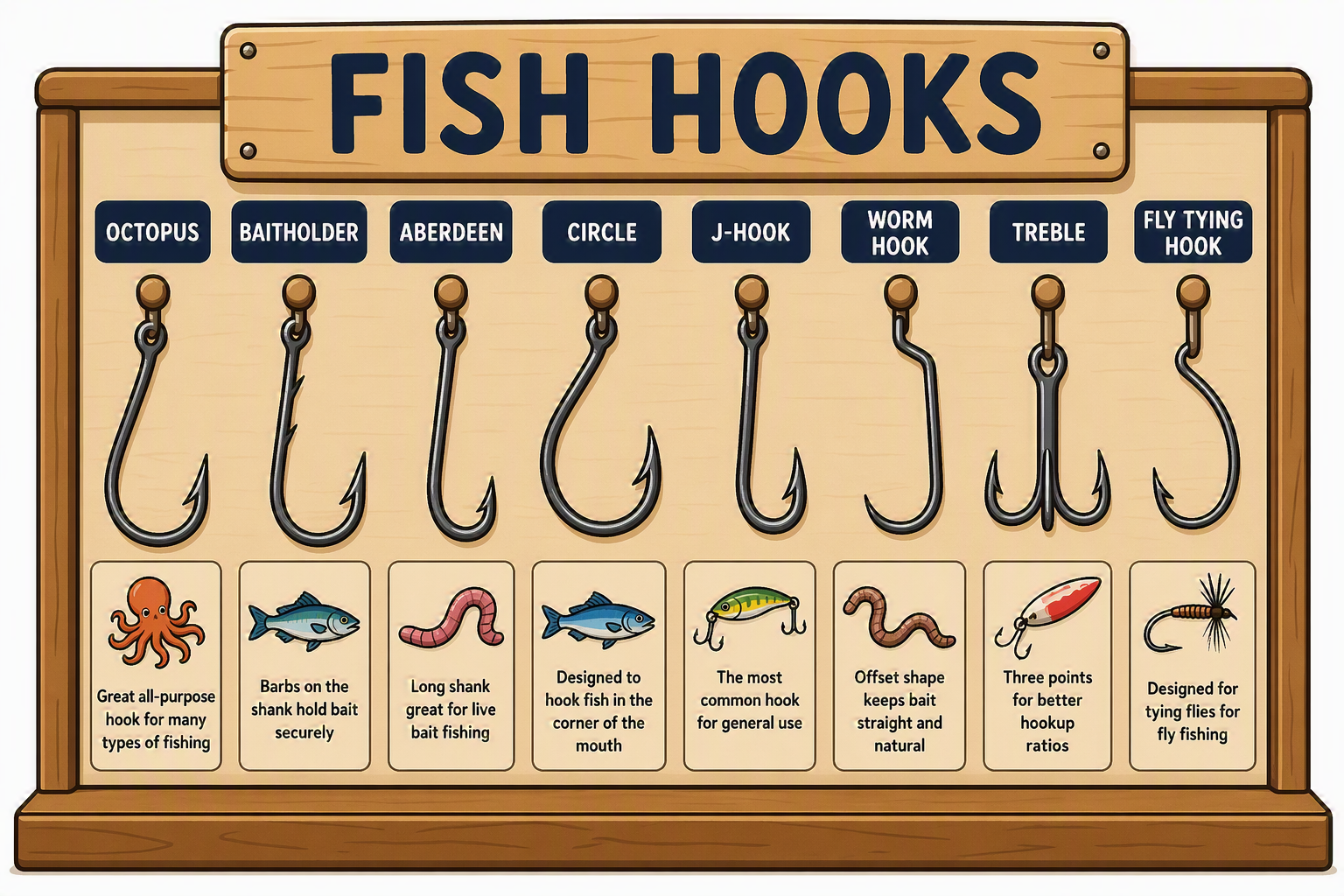
Aberdeen hooks have a long shank and fine wire. They are ideal for fishing live minnows, particularly for crappies. Their thin wire causes minimal damage to bait, and the long shank makes hook removal easier. They can also sometimes be bent free from snags. The downside is that they can straighten under the strain of larger fish. They are effective for crappie, bluegill, and perch and are widely regarded as a classic Midwestern crappie hook.
Circle hooks have points that curve sharply inward toward the shank. They are most commonly used with live bait and passive presentations. Instead of a hard hookset, the fish effectively hooks itself as the line tightens. Their major advantage is a lower rate of deep-hooked fish, making catch-and-release easier. They are particularly popular for catfish and carp.
Worm hooks feature an offset bend near the eye and are designed primarily for rigging soft plastic worms and other artificial baits. They are a staple of bass fishing.
Treble hooks consist of three hooks joined together. They are commonly found on crankbaits, spoons, and spinners and are used for bass, walleye, trout, and pike. They are generally not used with natural bait.
Finally, fly-tying hooks are small, lightweight hooks specifically designed for tying artificial flies.
For the type of fishing I currently do, I have found that barbless octopus hooks in sizes 4, 6, and 8 handle most of the species I am targeting and simplify both hook removal and catch-and-release fishing.
 OneHundredFish