I wasn’t expecting today’s fishing trip to produce a new species for my list. To my surprise, I ended up catching not one but three Mooneyes from two different spots on the Zumbro River.
The first two came from a stretch of the river near the small town of Theilman, Minnesota. The third was caught about 10 miles downstream near Kruger campground.
At both locations I was fishing a small red worm on a size 8 hook with a sinker about a foot above it. I started with a 1/4-ounce sinker and later switched to a 1/2-ounce sinker.
Catching these fish was interesting. I would get fairly firm bites, but then there would be little resistance for a few seconds. When I finally decided to check whether I actually had a fish on the line, I discovered that I did. They didn’t fight much at first, but as they neared shore they came alive and put up a surprisingly strong battle.
I was excited when I first saw one because it was bright silver and a decent size and quite beautiful zagging back and forth in the clear water. While reeling it in, I imagined it might be a Silver Redhorse, a species I still need for my list. Once I landed it, I briefly wondered whether it might be a White Bass. The large bulging eye, however, immediately caught my attention and seemed very different from the eye of a White Bass.
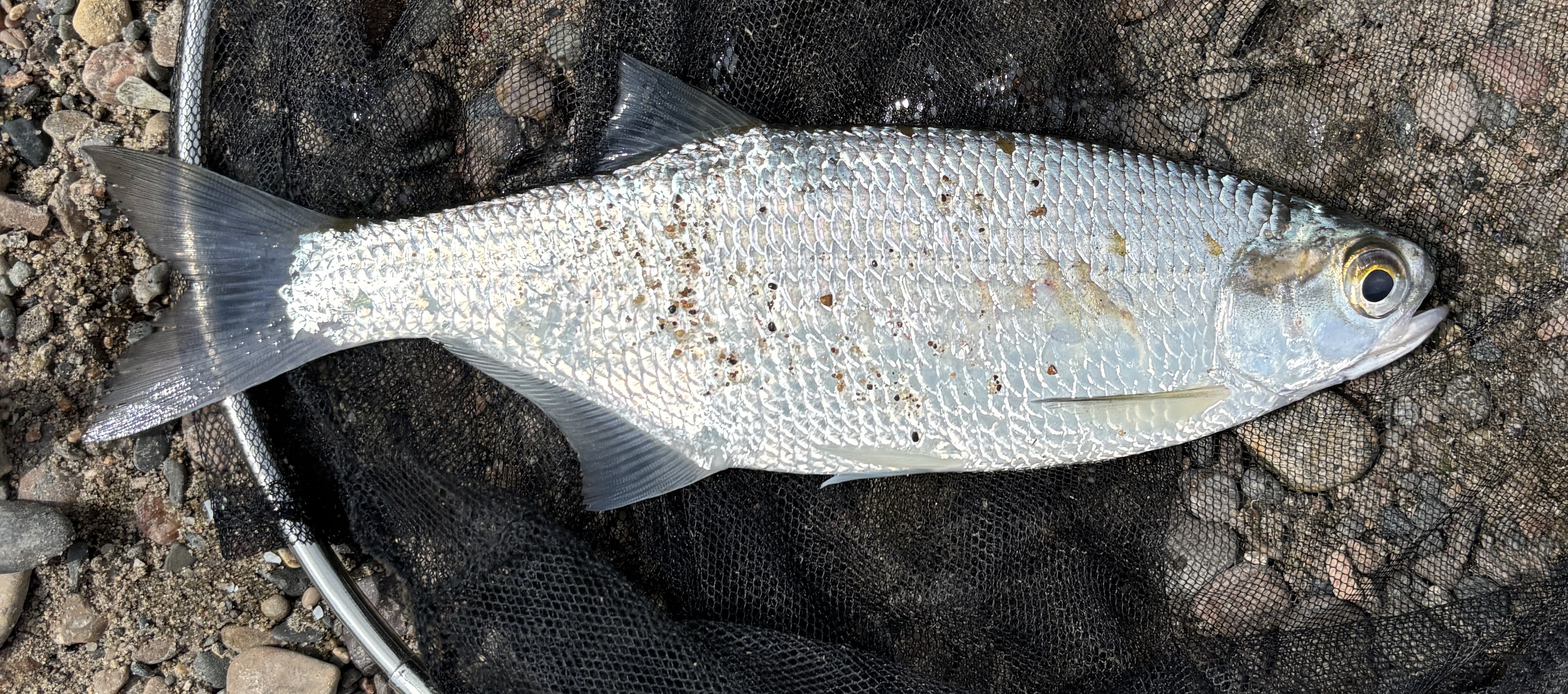
I uploaded a photo to iNaturalist and was delighted when it identified the fish as a Mooneye.
The fish were also larger than I expected. For some reason, I had always imagined Mooneyes as relatively small fish, perhaps even smaller than Bluegills. Instead, the three I caught were all around 10 to 12 inches long. I caught the first two in a deep pool just beyond a seam in the river.
My afternoon of fishing was accompanied by somewhat amusing, but also somewhat annoying, bellowing cows. They were standing in the river about fifty yards upstream from where I was fishing and seemed determined to make their presence known.
Near the end of my time at Theilman, a couple of canoeists pulled out while I was fishing. One asked whether I had caught anything.
“A couple of fish,” I replied.
“What kind?”
“I think they’re Mooneyes.”
He looked puzzled.
“You know what those are, right?” I asked.
“Some kind of sucker?”
I was pretty sure they weren’t (I double checked and they aren’t) but I simply agreed to spare him any embarrassment and bring the conversation to a graceful conclusion. He then told me he had caught a couple of Smallmouth Bass on a jig while floating down the river.
I enjoy catching Smallmouth as much as anyone, but sometimes it seems as though everyone is chasing the same handful of popular sport fish when there is such remarkable diversity swimming beneath the surface. Discovering unfamiliar species is one of the things I enjoy most about fishing.
The Mooneye (Hiodon tergisus) is a primitive North American freshwater fish known for its large, silvery, reflective eyes, which give it both its appearance and its common name. It belongs to the family Hiodontidae, one of the oldest surviving lineages of ray-finned fishes in North America.
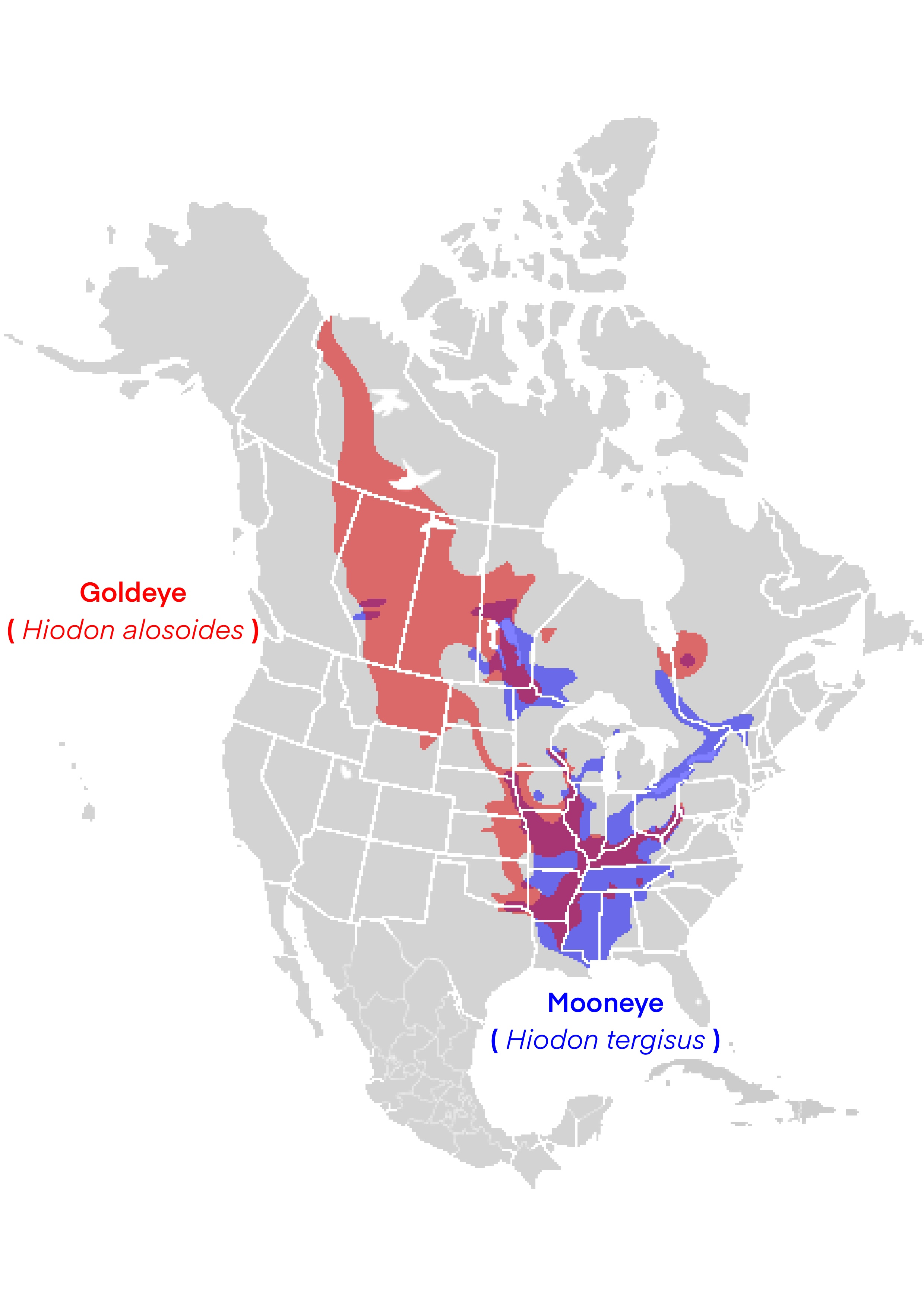
Mooneyes are widely distributed across eastern and central North America, including the Mississippi River drainage and the Great Lakes region. Minnesota lies right in the middle of their range.
They can reach nearly 19 inches in length, although fish in the 10 to 12 inch range are more typical, which was approximately the size of the three I caught. I was genuinely surprised by their size because I had somehow formed the impression that mooneyes were much smaller fish.
Mooneyes prefer rivers, lakes, and ponds and are often associated with relatively clear water, which fit the conditions on the Zumbro that day. They are slender, bright silver fish with very large eyes, a deeply forked tail, a single dorsal fin, and a body shape somewhat reminiscent of a herring or shad.
The eyes contain a reflective layer that helps them see in low-light conditions, making them particularly active at dawn, dusk, and during the night. They are opportunistic predators that feed on aquatic insects, other invertebrates, and small fish. As mentioned above, mine apparently had no objection to adding small red worms to their menu. They often feed near the surface and may sometimes be seen chasing insect hatches.
The Mooneye’s closest living relative is the Goldeye (Hiodon alosoides). Both belong to the genus Hiodon. Goldeyes generally prefer murkier water and are distinguished by their golden-colored irises.
Although Mooneyes are rarely targeted by anglers, they are strong fighters on light tackle and are frequently caught incidentally by fishermen pursuing Bass, Walleye, or Trout. They also play an important role as forage fish in many river ecosystems.
From an evolutionary standpoint, mooneyes are particularly fascinating. They are sometimes described as living fossils because their lineage stretches back at least 50 million years to the Eocene Epoch. Fossils of related species have been found across western North America, providing a glimpse into a remarkably ancient branch of the fish family tree.
 OneHundredFish