Yesterday I headed to the Faribault, Minnesota, area, about an hour west of Rochester, hoping to catch something new for my list—perhaps a Common Carp, Bigmouth Buffalo, or Smallmouth Buffalo. I didn’t manage to catch any of those species, but I did catch quite a few fish over the course of the day.
I started by fishing below Smith Mill Dam. I should never complain about catching fish, but it became a little frustrating when I found myself catching bullhead after bullhead, most of them Black Bullheads. I lost track, but I probably caught around 15 of them. I also caught one Smallmouth Bass.
At one point during the morning I noticed what looked like a black oil slick floating on the water. At first I dismissed it as possible pollution. Later, however, I caught a tiny, jet-black fish no larger than a minnow.
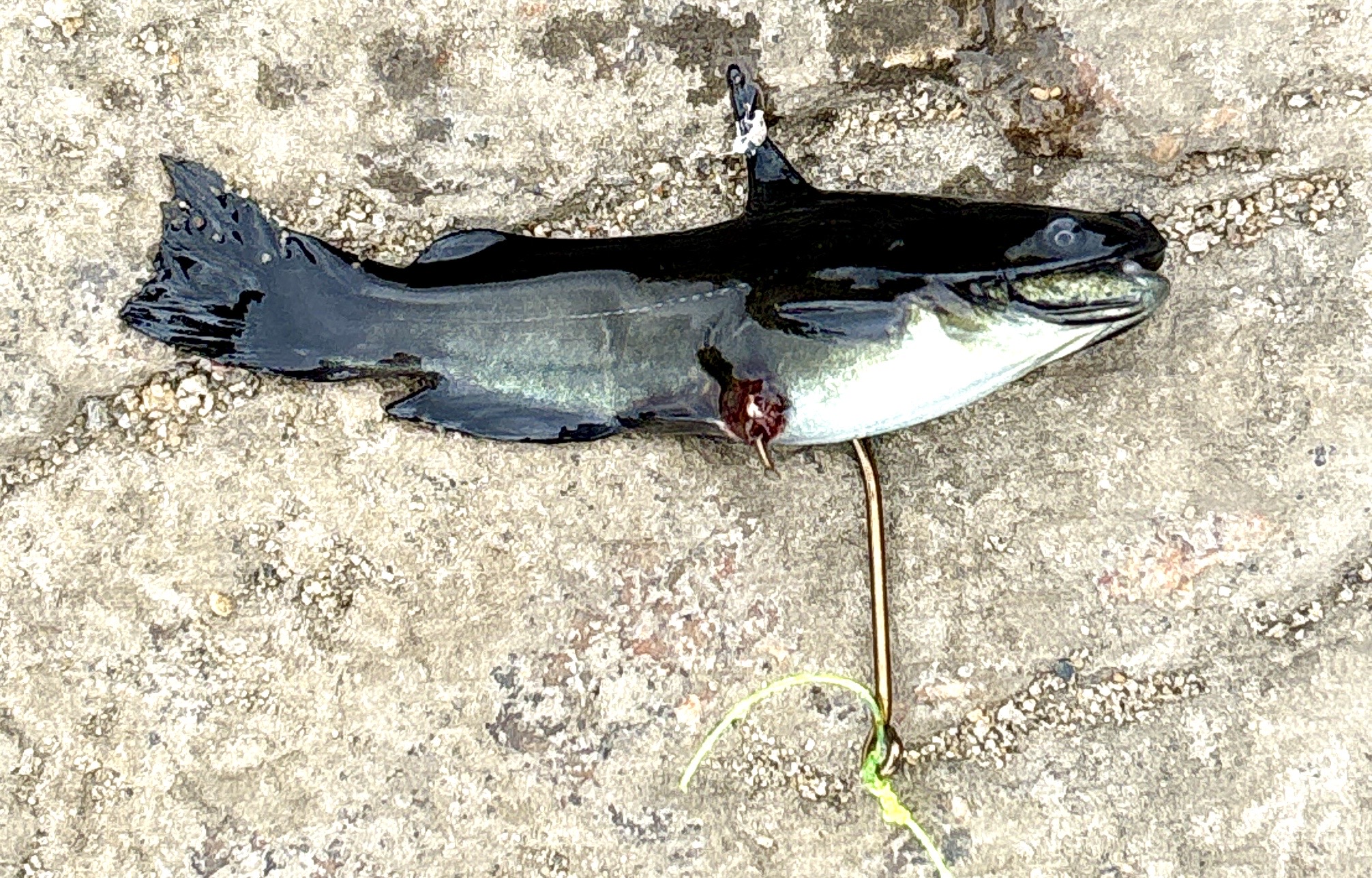
You can see that it is not much bigger than the hook on which I caught it. In fact, I actually snagged it. I was puzzled by what it was, so I posted the photo to iNaturalist, which identified it as a Black Bullhead. Incidentally, the little rascal managed to poke me with its prominent dorsal spine through my rubber glove while I was unhooking it.
The catch made me think again about the mysterious black slick I had noticed earlier, which was still drifting near where I was fishing. I took a closer look and suddenly realized that the “oil slick” was actually an enormous school of minnow-sized Black Bullheads. The school was at least five feet long and about a foot wide, and I would estimate it contained several thousand fish.
After doing a little research, I discovered that I had witnessed a phenomenon that appears only briefly each summer—a classic young-of-the-year bullhead swarm. Black Bullheads produce extremely large broods, often numbering between 2,000 and 10,000 fry. After hatching, the fry stay together in a tightly coordinated school that moves almost like a single organism. The group is so dense and dark that it resembles a drifting shadow in the water.
These swarms are typically only a few square feet in size but can contain thousands of jet-black, minnow-sized fry packed so tightly that they appear almost solid. They are usually found in warm, shallow areas with little current. The location where I observed them was a perfect fit.
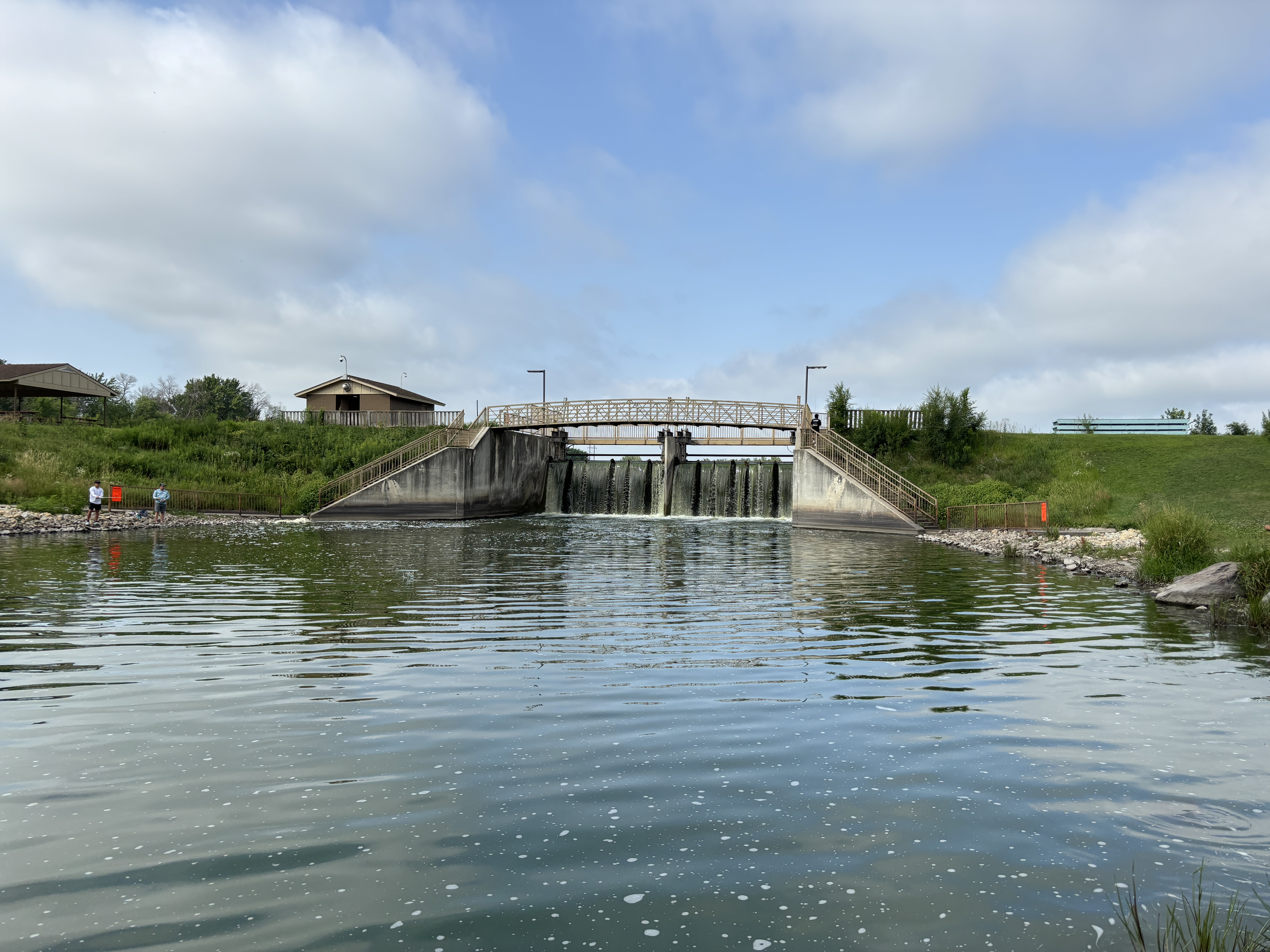
They were gathered below the dam because bullhead fry prefer warm water, slow current, abundant plankton, and relative protection from predators. The tailwater at Smith Mill provides all of these conditions, and it is common for fry to congregate in sheltered pockets downstream of small dams.
Young bullheads form these dense schools as a predator-avoidance strategy. The swarm makes it more difficult for predators to target individual fish, allows the group to move as a coordinated unit, helps keep the fry in suitable habitat, and provides safety in numbers during one of the most vulnerable stages of their lives. Adult bullheads sometimes guard the young early on, but even after parental care ends, the fry continue schooling until they grow larger.
Bullhead fry swarms are not commonly seen because they exist for only a few weeks each year. So, while I spent much of the morning catching what seemed like an endless succession of bullheads, I was ultimately rewarded with a rare sight. In the end, discovering that living “oil slick” made the morning’s run of bullheads much more understandable—and much more satisfying.
 OneHundredFish