I left Atlanta yesterday morning to head home, with a hotel booked in St. Charles, Missouri. On the way out of town, I stopped to fish several spots at Red Top Mountain State Park just north of Atlanta. Despite the beautiful weather, I had absolutely no bites anywhere, which made the day disappointing from a fishing perspective.
Today more than made up for it.
I left St. Charles around 8 a.m. and drove north into Iowa to buy a one‑day fishing license and fish Coralville Lake just north of Iowa City. My plan was to fish both below the dam in the tailwaters and then above the dam.
I started below the Coralville Dam Spillway. It had been sprinkling before I arrived, so I stopped at Scheel’s and bought a raincoat. Naturally, that ended the rain completely. Once I began fishing, there was no drizzle at all. The sun came and went, it was about 55°F, and a breeze made it feel a little chilly.
Roughly five to ten people were fishing along the shore of the tailwaters, along with about five American White Pelicans. One of the pleasures of fishing is that it forces you to slow down and notice things, and watching the somewhat comical pelicans was a highlight. They are enormous birds, with wingspans approaching nine feet. Their bodies are brilliant white with black flight feathers, and their bright orange legs and feet are especially noticeable when they take off, which they did periodically as they moved upstream and downstream searching for fish.
The water pours forcefully out of the base of the dam, creating a very strong current for roughly an eighth of a mile downstream. I was targeting Largemouth Bass, first with a large chartreuse spinnerbait and then with a smaller orange chatterbait. I didn’t get a single bite and quickly lost the chatterbait to a snag.
In addition to the adults fishing, there was a group of about eight kids—probably around ten years old—fishing with literal sticks rigged with line, hooks, and bait that their chaperone was putting on for them. They were catching fish after fish. The fish were tiny, but the kids were thrilled, and it genuinely warmed my heart. At the same time, I was getting frustrated by the complete lack of bites on my end and briefly considered joining them in their panfish frenzy.
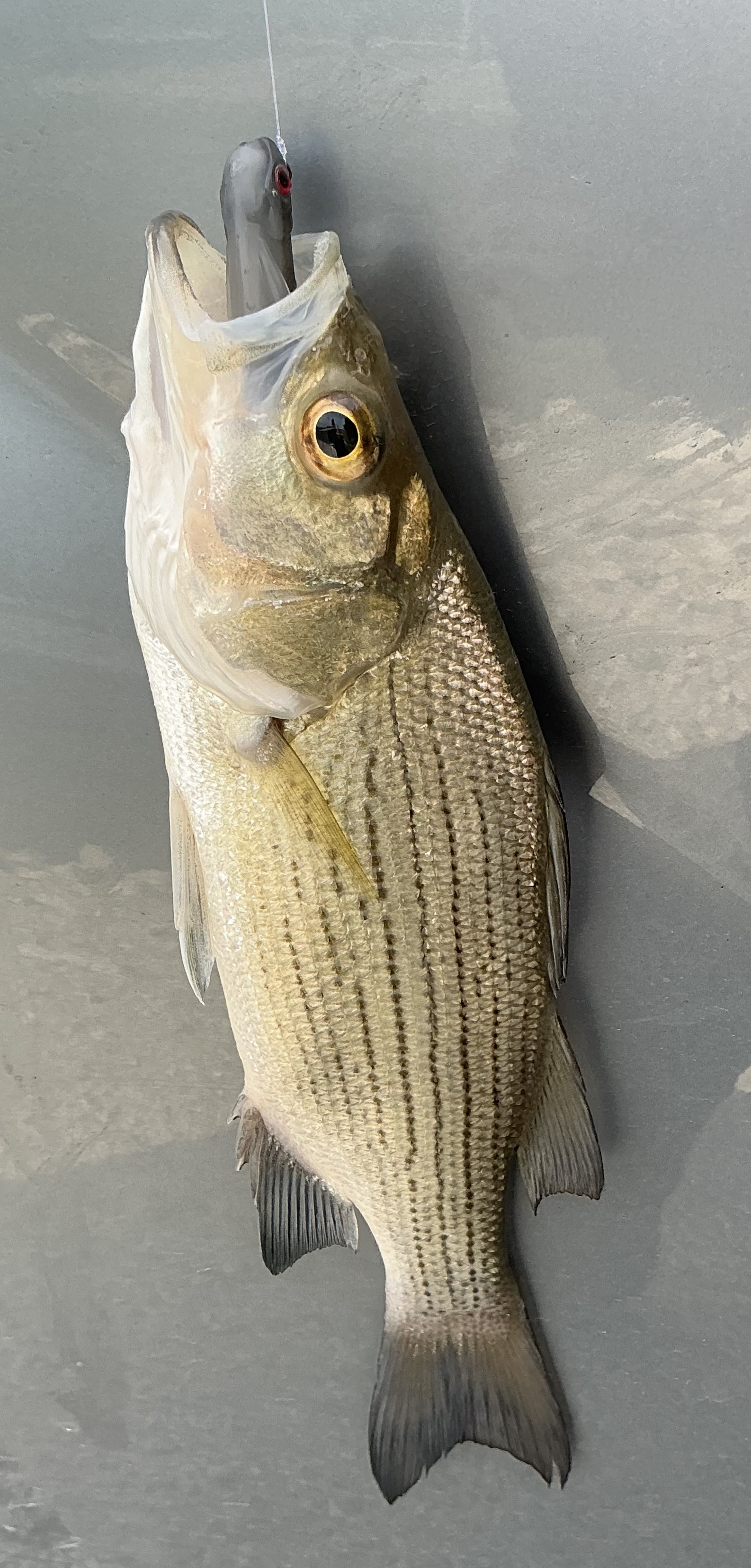
Instead, I tied on an approximately two‑inch gray swimbait with a red eye and retrieved it very slowly. Near shore, I got a strong bite. It took some effort to land the fish. At first glance, I thought it was a White Bass—already on my species list—and nearly skipped taking a photo. Thankfully, I decided to document it.
That was when my iPhone informed me that my photo storage was full. I ran back to my car, grabbed my iPad, and took a picture. When I uploaded it to iNaturalist, their AI identified it as a White Bass. Shortly afterward, an identifier with the handle flylinesardine disagreed, suggesting it was actually a Wiper. Another identifier, wes_inc, agreed that it was Wiper, elevating the observation to Research Grade.
I had only recently learned what a Wiper is while preparing for my 100‑fish adventure. A Wiper is a hybrid of a White Bass and a Striped Bass (sometimes referred to as a Striper), a cross that didn’t exist until the 1970s—so it’s not surprising that I initially misidentified it.
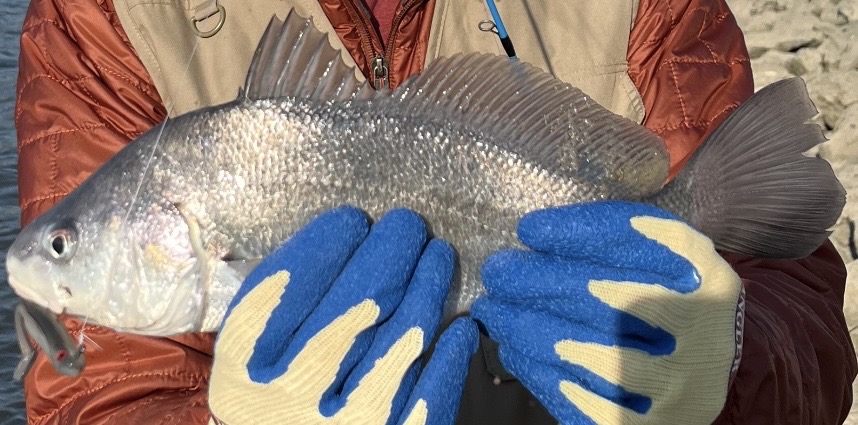
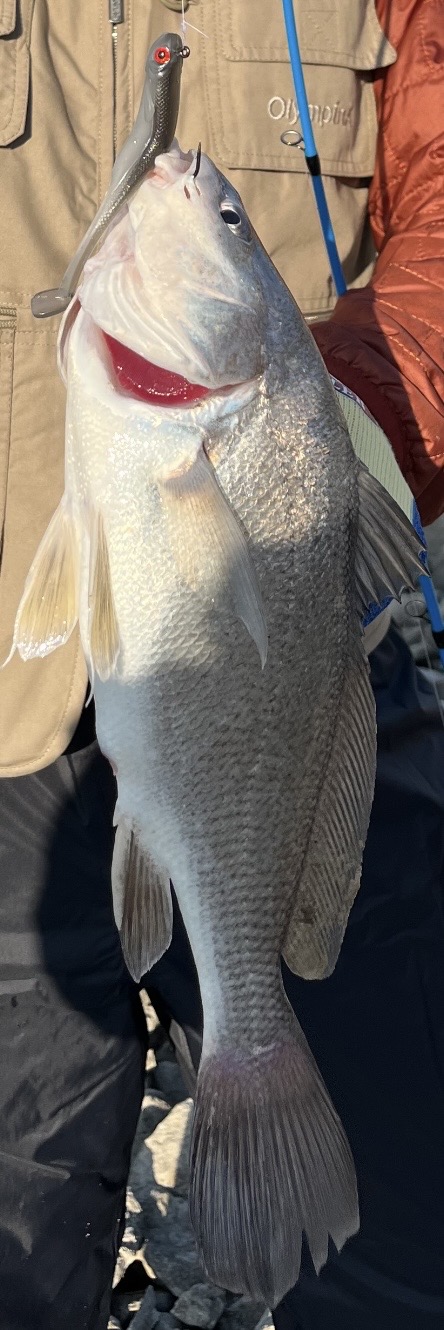
After fishing a bit longer in the tailwaters with no additional bites, I moved to the top of the dam to fish the riprap along the face of the dam. Four college‑aged guys were fishing there as well. After about five casts with the same swimbait, I got another strong bite. It took about 20 seconds to land and was clearly a new species for me, though I didn’t know which one.
Once again, my iPhone refused to take photos, so I asked one of the guys—Cameron—if he could take pictures of me with the fish and of the fish alone and email them to me. He kindly did. When I posted the photos to iNaturalist, the AI identified the fish as a Freshwater Drum. Several identifiers agreed, making it another Research Grade observation.
Fishing often leads to easy conversations, and I asked Cameron how long he’d been fishing and whether he and his friends were in college. He told me they all attended the University of Iowa and that he’d been fishing since childhood.
As the sun dropped lower, the others left, and I had the dam mostly to myself. I stayed a while longer, no longer concerned about catching anything, enjoying the birds instead: Purple Martins and other swallows skimming the water, a small kettle of Turkey Vultures soaring overhead, and the onomatopoeic call of a Killdeer nearby.
After a few more casts, I called it quits. It had been a wonderful day.
 OneHundredFish